
Kreisklinik Groß-Umstadt
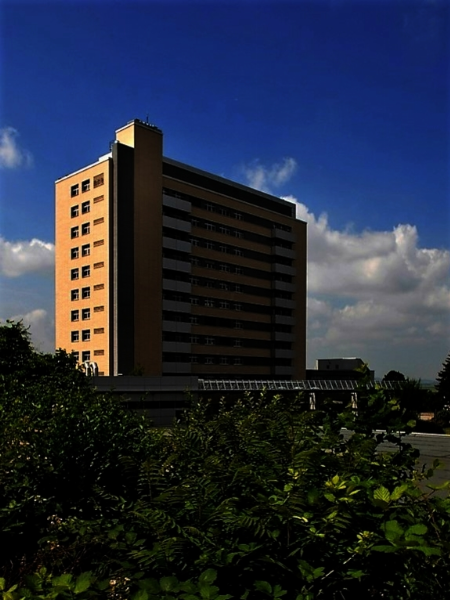
Krankenhausstr. 11
64823 Groß-Umstadt
Phone:
06078-790
Mail:
ed.idad-nekinilksierk@ofni
ed.idad-nekinilksierk@ofni
ed.idad-nekinilksierk@ofni
- Number of beds: 361
- Number of specialist departments: 13
- Number of inpatient cases: 11.306
- Number of partial inpatient cases: 189
- Number of outpatient cases: 42.000
- Number of cases of inpatient-equivalent psychiatric treatment (StäB): 74
- Hospital owners: Landkreis Darmstadt-Dieburg
- Type of provider: öffentlich
- Klinik für Innere Medizin I (Allg. Innere und Gastroenterologie)
- Klinik für Anästhesie und Intensivmedizin
- Belegklinik für HNO-Erkrankungen
- Klinik für Radiologie
- Allgemeine Psychiatrie, Stationsäquivalente Behandlung in der Privatwohnung
- Klinik für Innere Medizin II (Kardiologie)
- Klinik für Geriatrie
- Klinik für Geriatrie/Tagesklinik
- Klinik für Allgemein- und Viszeralchirurgie
- Klinik für Unfallchirurgie und Orthopädie
- Klinik für Plastische und Ästhetische Chirurgie/ Gesichtschirurgie
- Klinik für Frauenheilkunde und Geburtshilfe
- Zentrum für Seelische Gesundheit (Allgemeine Psychiatrie)
Further information
| Bezeichnung | |
| Teilnahme externe Qualitätssicherung | yes |
| Bezeichnung | |
| Teilnahme externe Qualitätssicherung | yes |
- Quality of participation in the Disease Management Programme (DMP)
No participation
| Quantity performed | 1 |
| Exception? | No exception |
| Overall result forecast presentation: | no |
| Quantity performed reporting year: | 1 |
| Quantity forecast year: | 0 |
| Examination by state associations? | no |
| Exemption? | no |
| Result of the examination by the federal state authorities? | no |
| Transitional arrangement? | no |
- Implementation of resolutions of the Federal Joint Committee on quality assurance (G-BA)
No participation
- Clarifying chat completed: no
- Clarifying chat not completed: no
- No participation in clarifying chat: no
- Notification of non-fulfilment of nursing care not made: no
quarter Q1
Erwachsenenpsychiatrie
| Day shift | ||
|---|---|---|
| Compliance with minimum requirements | yes | |
| Level of implementation | 100,0 % | |
| Occupational group | Minimum requirements met | Level of implementation (%) |
| Ärztinnen und Ärzte, ärztliche Psychotherapeutinnen und Psychotherapeuten | ja | 109,39 % |
| Pflegefachpersonen | nein | 94,45 % |
| Psychotherapeutinnen und Psychotherapeuten (ohne ärztliche Psychotherapeutinnen und Psychotherapeuten), Psychologinnen und Psychologen | ja | 172,64 % |
| Spezialtherapeutinnen und Spezialtherapeuten | ja | 99,15 % |
| Bewegungstherapeutinnen und Bewegungstherapeuten, Physiotherapeutinnen und Physiotherapeuten | nein | 92,48 % |
| Sozialarbeiterinnen und Sozialarbeiter, Sozialpädagoginnen und Sozialpädagogen, Heilpädagoginnen und Heilpädagogen | nein | 91,09 % |
quarter Q2
Erwachsenenpsychiatrie
| Day shift | ||
|---|---|---|
| Compliance with minimum requirements | yes | |
| Level of implementation | 91,0 % | |
| Occupational group | Minimum requirements met | Level of implementation (%) |
| Ärztinnen und Ärzte, ärztliche Psychotherapeutinnen und Psychotherapeuten | ja | 97,13 % |
| Pflegefachpersonen | nein | 88,41 % |
| Psychotherapeutinnen und Psychotherapeuten (ohne ärztliche Psychotherapeutinnen und Psychotherapeuten), Psychologinnen und Psychologen | ja | 156,73 % |
| Spezialtherapeutinnen und Spezialtherapeuten | nein | 85,33 % |
| Bewegungstherapeutinnen und Bewegungstherapeuten, Physiotherapeutinnen und Physiotherapeuten | ja | 100,6 % |
| Sozialarbeiterinnen und Sozialarbeiter, Sozialpädagoginnen und Sozialpädagogen, Heilpädagoginnen und Heilpädagogen | nein | 73,4 % |
| Night shift | ||
| Compliance with minimum requirements | no | |
| Minimum requirement (full-time staff) | 48 | |
| Current staffing levels (full-time staff) | 55 | |
| Number of nights, subject to the minimum requirement | 91 | |
quarter Q3
Erwachsenenpsychiatrie
| Day shift | ||
|---|---|---|
| Compliance with minimum requirements | no | |
| Level of implementation | 95,0 % | |
| Occupational group | Minimum requirements met | Level of implementation (%) |
| Ärztinnen und Ärzte, ärztliche Psychotherapeutinnen und Psychotherapeuten | ja | 102,79 % |
| Pflegefachpersonen | ja | 90 % |
| Psychotherapeutinnen und Psychotherapeuten (ohne ärztliche Psychotherapeutinnen und Psychotherapeuten), Psychologinnen und Psychologen | ja | 137,17 % |
| Spezialtherapeutinnen und Spezialtherapeuten | ja | 99,55 % |
| Bewegungstherapeutinnen und Bewegungstherapeuten, Physiotherapeutinnen und Physiotherapeuten | ja | 96,74 % |
| Sozialarbeiterinnen und Sozialarbeiter, Sozialpädagoginnen und Sozialpädagogen, Heilpädagoginnen und Heilpädagogen | ja | 94,33 % |
| Night shift | ||
| Compliance with minimum requirements | no | |
| Minimum requirement (full-time staff) | 48 | |
| Current staffing levels (full-time staff) | 58 | |
| Number of nights, subject to the minimum requirement | 92 | |
quarter Q4
Erwachsenenpsychiatrie
| Day shift | ||
|---|---|---|
| Compliance with minimum requirements | yes | |
| Level of implementation | 89,0 % | |
| Occupational group | Minimum requirements met | Level of implementation (%) |
| Ärztinnen und Ärzte, ärztliche Psychotherapeutinnen und Psychotherapeuten | ja | 97,02 % |
| Pflegefachpersonen | nein | 85,01 % |
| Psychotherapeutinnen und Psychotherapeuten (ohne ärztliche Psychotherapeutinnen und Psychotherapeuten), Psychologinnen und Psychologen | ja | 149,32 % |
| Spezialtherapeutinnen und Spezialtherapeuten | nein | 72,35 % |
| Bewegungstherapeutinnen und Bewegungstherapeuten, Physiotherapeutinnen und Physiotherapeuten | ja | 90,06 % |
| Sozialarbeiterinnen und Sozialarbeiter, Sozialpädagoginnen und Sozialpädagogen, Heilpädagoginnen und Heilpädagogen | nein | 89,35 % |
| Night shift | ||
| Compliance with minimum requirements | no | |
| Minimum requirement (full-time staff) | 48 | |
| Current staffing levels (full-time staff) | 61 | |
| Number of nights, subject to the minimum requirement | 92 | |
Full record of compliance maintained
| Number of days shown | 366 |
| Days of non-performance | 0 |
| Number of minimum requirements not met | 0 |
General minimum requirements
| Minimum requirement | Days of non-performance |
|---|---|
| Trauma room | 0 |
| Availability | 0 |
| Computed tomography (CT) | 0 |
| Intensive care beds | 0 |
| Department of Surgery | 0 |
| Forwarding by air | 0 |
| Department of Internal Medicine | 0 |
| Intensive care beds with ventilator facilities | 0 |
| Emergency care training courses | 0 |
| Treatment prioritisation system (triage) | 0 |
| Responsibility for emergency care | 0 |
Specific minimum requirements
| Minimum requirement | Days of non-performance |
|---|---|
| Doctor on duty | 0 |
| Supervision by a medical specialist | 0 |
| Geriatric expertise | 0 |
| Operating room equipment | 0 |
| Post-operative physiotherapy | 0 |
| Independent organisational unit | 0 |
Minimum requirements for process quality
| Minimum requirement | Days of non-performance |
|---|---|
| SOP: Surgical procedures | 0 |
| SOP: Perioperative Planning | 0 |
| SOP: Capacity to consent | 0 |
| Standard Operating Procedure for the Management of Anticoagulants | 0 |
| SOP: Ortho-geriatric Care | 0 |
| SOP: Physiotherapy Measures | 0 |
| SOP: Patient-centred blood management | 0 |
| Number | Group |
|---|---|
| 81 | Medical specialists (m/f) , psychological psychotherapists (m/f) and child and adolescent psychotherapists (m/f) who are subject to the obligation to undergo further training* |
| 16 | Number of medical specialists (m/f) from no. 1 who have completed a five-year period of further training and are therefore subject to the obligation to provide evidence |
| 16 | Number of those persons from no. 2 who have provided proof of further training according to Article 3 of the G-BA regulations |
According to Section 4 (2) of the Quality Management Guideline, facilities must provide for the prevention of and intervention in cases of violence and abuse as part of their internal quality management. The aim is to prevent, recognise and respond appropriately to abuse and violence, particularly against vulnerable patient groups such as children and adolescents or people in need of help, and also to prevent it within the facility. The respective procedure is aligned with the size of the facility, the range of services and the patients in order to define customised solutions for sensitising the teams as well as other suitable preventative and interventional measures. These may include information materials, contact addresses, training/education, codes of conduct, recommendations for action/intervention plans or comprehensive protection concepts.
- Is a protection concept in place? Yes
- No care for children and young people
- Drug commission
Training of employees on AMTS related topics
- Bereitstellung einer geeigneten Infrastruktur zur Sicherstellung einer fehlerfreien Zubereitung
- Zubereitung durch pharmazeutisches Personal
- Anwendung von gebrauchsfertigen Arzneimitteln bzw. Zubereitungen
- Fallbesprechungen
- Maßnahmen zur Vermeidung von Arzneimittelverwechslung
- Spezielle AMTS-Visiten (z. B. pharmazeutische Visiten, antibiotic stewardship, Ernährung)
- Aushändigung des Medikationsplans
- bei Bedarf Arzneimittel-Mitgabe oder Ausstellung von Entlassrezepten
- Admission to hospital, including anamnesis
; Instruments and measures are presented for determining the old medication (drug history), the subsequent clinical assessment and the switch to the medication available in the hospital (house list), as well as for documenting both the patient's original medication and that for hospital treatment adapted medication.
- Medication process in the hospital
In this context, the following sub-processes are assumed as examples: drug history - prescription - patient information - drug delivery - drug use - documentation - therapy monitoring - result assessment. Instruments and measures for safe medication prescription can be presented, e.g. B. in terms of readability, clarity and completeness of the documentation, but also in terms of area of application, effectiveness, benefit-risk ratio, tolerability (including potential contraindications, interactions, etc.) and resource considerations. Information can also be provided to support reliable medication ordering, delivery and use or administration.
- Discharge
In particular, the measures taken by hospitals can be presented to ensure that information on drug therapy is structured and passed on to doctors and physicians providing further treatment, as well as the appropriate provision of patients with drug information, medication plans and medications. Drug prescriptions are made.
Job
FL01 - Lectureships / teaching posts at colleges and universities
Explanation
FL03 - Student training (clinical traineeship / internship year)
Explanation
Training in other healing professions
HB03 - Physical therapist / physiotherapist (m/f)
Comment
Comment
Eigene Krankenpflegeschule: https://karriere.kreiskliniken-dadi.de/ausbildung-zur-pflegefachperson/
HB10 - Midwife (m/f)
Comment
HB07 - Surgical technical assistant (m/f)
Comment
- Hospital staff
- Number of pharmacists: 15
- Additional staff: 43
- Explanations: Bären-Apotheke Erbach
Renate Filip
Patientenfürsprecherin
Krankenhausstr. 11
64823 Groß-Umstadt
Phone:
06078
-79-0
Mail:
ed.idad-nekinilksierk@ug_rehcerpsreufnetneitap
Marion Thürmer
Patientenfürsprecherin
Krankenhausstr. 11
64823 Groß-Umstadt
Phone:
06078
-79-0
Mail:
ed.idad-nekinilksierk@ug_rehcerpsreufnetneitap
Yasemin Karaman
Mitarbeiterin Qualitätsmanagement
Krankenhausstr. 11
64823 Groß-Umstadt
Phone:
06078
-79-1031
Mail:
ed.idad-nekinilksierk@namarak.y
Yasemin Karaman
Mitarbeiter Qualitätsmanagement
Krankenhausstr. 11
64823 Groß-Umstadt
Phone:
06078
-79-1031
Mail:
ed.idad-nekinilksierk@namarak.y
Frank Buffleb
Inhaber und Geschäftsführer der Bären ApothekeHauptstraße 2764711 Erbach
Krankenhausstr. 11
64823 Groß-Umstadt
Phone:
06062
-9439-110
Mail:
ed.wdo-opa@belffub.knarf
Christian Flach
Schwerbehindertenbeauftragter
Krankenhausstr. 11
64823 Groß-Umstadt
Phone:
06078
-79-4002
Mail:
ed.idad-nekinilksierk@hcalf.c
64823 Groß-Umstadt
Phone:
06078-790
Mail:
ed.idad-nekinilksierk@ofni
Jens Müller-Laupert
Pflegedienstleiter
Krankenhausstr. 11
64823 Groß-Umstadt
Phone:
06078
-79-1200
Mail:
ed.idad-nekinilksierk@trepual-relleum.j
Christoph Dahmen
Betriebsleiter
Krankenhausstr. 11
64823 Groß-Umstadt
Phone:
06078
-79-1000
Mail:
ed.idad-nekinilksierk@gnutielsbeirteb
Pelin Meyer
Betriebsleiterin, Fachanwältin für Medizinrecht
Krankenhausstr. 11
64823 Groß-Umstadt
Phone:
06078
-79-1000
Mail:
ed.idad-nekinilksierk@gnutielsbeirteb
Christoph Dahmen
Betriebsleiter/ Verwaltungsleiter
Krankenhausstr. 11
64823 Groß-Umstadt
Phone:
06078
-79-1000
Mail:
ed.idad-nekinilksierk@gnutielsbeirteb
Prof. Dr. med. Peter Schräder
Ärztlicher Leiter, Chefarzt - Facharzt Orthopädie, Unfallchirurgie und Rheumatologie
Krankenhausstr. 11
64823 Groß-Umstadt
Phone:
06078
-79-2501
Mail:
ed.idad-nekinilksierk@redearhcs.p
IK: 260610690
Location number: 772772000
Zentrum für Adipositas- und metabolische Chirurgie
Certified until: 09.2027