
Kinder- und Jugendkrankenhaus AUF DER BULT
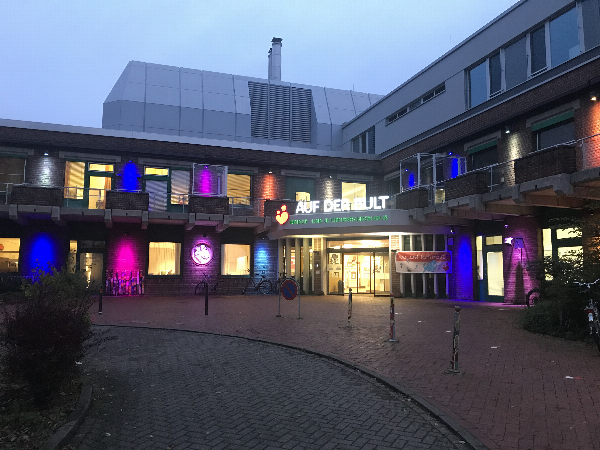
Janusz-Korczak-Allee 12
30173 Hannover
Phone:
0511-8115-0
Mail:
ed.akh@ofni
ed.akh@ofni
ed.akh@ofni
- Number of beds: 251
- Number of specialist departments: 10
- Number of inpatient cases: 8.552
- Number of partial inpatient cases: 2.587
- Number of outpatient cases: 44.100
- Hospital owners: Stiftung Hannoversche Kinderheilanstalt
- Type of provider: freigemeinnützig
- Academic teaching hospital
- Medizinische Hochschule Hannover (MHH)
- Semmelweis Universität Asklepios Campus Hamburg
- Allgemeine Kinderheilkunde I, Neonatologie, Kinderkardiologie
- Anästhesie / Kinderintensiv- und Notfallmedizin
- Allgemeine Kinderheilkunde II, Neuropädiatrie
- Allgemeine Kinderheilkunde III, Diabetologie, Endokrinologie, Gastroenterologie und Klinische Forschung
- Kindermedizinische Tagesklinik
- Kinderchirurgie / Kinderurologie
- Hals-, Nasen-, Ohrenheilkunde
- Kinder- und Jugendpsychiatrie/Psychotherapie
- Kinder- und Jugendpsychiatrische Tagesklinik
- Kinderradiologie /Ultraschall / Computertomografie
Further information
- External quality assurance according to state law
No participation
Diabetes mellitus Typ 1
- Implementation of the minimum quantity agreement
No participation
| No. | Explanation |
|---|---|
| CQ05 | Measures for quality assurance in the care of pre-term and full-term neonates – Perinatal Centre LEVEL 1 |
- Clarifying chat completed: no
- Clarifying chat not completed: no
- No participation in clarifying chat: no
- Notification of non-fulfilment of nursing care not made: yes
quarter Q1
Kinder und Jugendpsychiatrie
| Day shift | ||
|---|---|---|
| Compliance with minimum requirements | yes | |
| Level of implementation | 96,0 % | |
| Occupational group | Minimum requirements met | Level of implementation (%) |
| Ärztinnen und Ärzte, ärztliche Psychotherapeutinnen und Psychotherapeuten | ja | 107,64 % |
| Pflegefachpersonen und Erziehungsdienst | ja | 96,63 % |
| Psychotherapeutinnen und Psychotherapeuten (ohne ärztliche Psychotherapeutinnen und Psychotherapeuten), Psychologinnen und Psychologen (dazu zählen alle Kinder- und Jugendlichenpsychotherapeutinnen und -psychotherapeuten) | nein | 68,43 % |
| Spezialtherapeutinnen und Spezialtherapeuten | nein | 23,62 % |
| Bewegungstherapeutinnen und Bewegungstherapeuten, Physiotherapeutinnen und Physiotherapeuten | ja | 214,53 % |
| Sozialarbeiterinnen und Sozialarbeiter, Sozialpädagoginnen und Sozialpädagogen, Heilpädagoginnen und Heilpädagogen | ja | 133,24 % |
| Night shift | ||
| Compliance with minimum requirements | no | |
| Minimum requirement (full-time staff) | 100 | |
| Current staffing levels (full-time staff) | 106 | |
| Number of nights, subject to the minimum requirement | 91 | |
quarter Q2
Kinder und Jugendpsychiatrie
| Day shift | ||
|---|---|---|
| Compliance with minimum requirements | yes | |
| Level of implementation | 93,0 % | |
| Occupational group | Minimum requirements met | Level of implementation (%) |
| Ärztinnen und Ärzte, ärztliche Psychotherapeutinnen und Psychotherapeuten | ja | 95,82 % |
| Pflegefachpersonen und Erziehungsdienst | ja | 95,94 % |
| Psychotherapeutinnen und Psychotherapeuten (ohne ärztliche Psychotherapeutinnen und Psychotherapeuten), Psychologinnen und Psychologen (dazu zählen alle Kinder- und Jugendlichenpsychotherapeutinnen und -psychotherapeuten) | ja | 105,76 % |
| Spezialtherapeutinnen und Spezialtherapeuten | nein | 52,52 % |
| Bewegungstherapeutinnen und Bewegungstherapeuten, Physiotherapeutinnen und Physiotherapeuten | ja | 96,9 % |
| Sozialarbeiterinnen und Sozialarbeiter, Sozialpädagoginnen und Sozialpädagogen, Heilpädagoginnen und Heilpädagogen | nein | 82,38 % |
| Night shift | ||
| Compliance with minimum requirements | no | |
| Minimum requirement (full-time staff) | 100 | |
| Current staffing levels (full-time staff) | 106 | |
| Number of nights, subject to the minimum requirement | 91 | |
quarter Q3
Kinder und Jugendpsychiatrie
| Day shift | ||
|---|---|---|
| Compliance with minimum requirements | yes | |
| Level of implementation | 100,0 % | |
| Occupational group | Minimum requirements met | Level of implementation (%) |
| Ärztinnen und Ärzte, ärztliche Psychotherapeutinnen und Psychotherapeuten | ja | 97,08 % |
| Pflegefachpersonen und Erziehungsdienst | ja | 100,54 % |
| Psychotherapeutinnen und Psychotherapeuten (ohne ärztliche Psychotherapeutinnen und Psychotherapeuten), Psychologinnen und Psychologen (dazu zählen alle Kinder- und Jugendlichenpsychotherapeutinnen und -psychotherapeuten) | ja | 112,26 % |
| Spezialtherapeutinnen und Spezialtherapeuten | nein | 88,22 % |
| Bewegungstherapeutinnen und Bewegungstherapeuten, Physiotherapeutinnen und Physiotherapeuten | ja | 134,14 % |
| Sozialarbeiterinnen und Sozialarbeiter, Sozialpädagoginnen und Sozialpädagogen, Heilpädagoginnen und Heilpädagogen | ja | 90,97 % |
| Night shift | ||
| Compliance with minimum requirements | no | |
| Minimum requirement (full-time staff) | 100 | |
| Current staffing levels (full-time staff) | 100 | |
| Number of nights, subject to the minimum requirement | 92 | |
quarter Q4
Kinder und Jugendpsychiatrie
| Day shift | ||
|---|---|---|
| Compliance with minimum requirements | yes | |
| Level of implementation | 84,0 % | |
| Occupational group | Minimum requirements met | Level of implementation (%) |
| Ärztinnen und Ärzte, ärztliche Psychotherapeutinnen und Psychotherapeuten | ja | 91,23 % |
| Pflegefachpersonen und Erziehungsdienst | nein | 82,73 % |
| Psychotherapeutinnen und Psychotherapeuten (ohne ärztliche Psychotherapeutinnen und Psychotherapeuten), Psychologinnen und Psychologen (dazu zählen alle Kinder- und Jugendlichenpsychotherapeutinnen und -psychotherapeuten) | ja | 96,15 % |
| Spezialtherapeutinnen und Spezialtherapeuten | nein | 64,1 % |
| Bewegungstherapeutinnen und Bewegungstherapeuten, Physiotherapeutinnen und Physiotherapeuten | ja | 118,96 % |
| Sozialarbeiterinnen und Sozialarbeiter, Sozialpädagoginnen und Sozialpädagogen, Heilpädagoginnen und Heilpädagogen | nein | 78,71 % |
| Night shift | ||
| Compliance with minimum requirements | no | |
| Minimum requirement (full-time staff) | 100 | |
| Current staffing levels (full-time staff) | 100 | |
| Number of nights, subject to the minimum requirement | 92 | |
| Number | Group |
|---|---|
| 69 | Medical specialists (m/f) , psychological psychotherapists (m/f) and child and adolescent psychotherapists (m/f) who are subject to the obligation to undergo further training* |
| 50 | Number of medical specialists (m/f) from no. 1 who have completed a five-year period of further training and are therefore subject to the obligation to provide evidence |
| 50 | Number of those persons from no. 2 who have provided proof of further training according to Article 3 of the G-BA regulations |
According to Section 4 (2) of the Quality Management Guideline, facilities must provide for the prevention of and intervention in cases of violence and abuse as part of their internal quality management. The aim is to prevent, recognise and respond appropriately to abuse and violence, particularly against vulnerable patient groups such as children and adolescents or people in need of help, and also to prevent it within the facility. The respective procedure is aligned with the size of the facility, the range of services and the patients in order to define customised solutions for sensitising the teams as well as other suitable preventative and interventional measures. These may include information materials, contact addresses, training/education, codes of conduct, recommendations for action/intervention plans or comprehensive protection concepts.
- Is a protection concept in place? Yes
- Measures
-
Prevention
- Note on the measure
https://www.auf-der-bult.de/anregungen-kritik und zusätzlich Beschwerdebriefkästen im Bereich der Kinder- und Jugendpsychiatrie
- Note on the measure
Präventionsmaßnahmen: z.B. erweiterte Führungszeugnisse und Selbstverpflichtungserklärungen. Patient*innen, Angehörige + Mitarbeitende werden durch Flyer und Internetseite des Krankenhauses informiert / sensibilisiert. Geschulte interne + externe Ansprechpersonen stehen zur Verfügung.
- Note on the measure
Informationsveranstaltungen und regelmäßige Schulungsangebote
- Note on the measure
Ein erweitertes Führungszeugnis ist eine Voraussetzung für die Einstellung der Mitarbeitenden.
- Note on the measure
Über einen QR-Code kann im Flyer direkt das Schutzkonzept mit enthaltenen Ansprechpersonen und Hilfs-Adressen aufgerufen werden. Das Schutzkonzept ist über die Internetseite des Krankenhauses für Patienten, Angehörige und Mitarbeitende zugänglich.
- Note on the measure
In den Patienten-Wartezonen und den Aufenthaltsräumen der Mitarbeitenden wurden Plakate und Flyer zum Thema platziert.
- Note on the measure
Der Umgangs- und Verhaltenskodex wird bei Einstellung jedem neuen Mitarbeitenden ausgehändigt.
- Last review of the measure
10.07.2025 21:33:50
- Note on the measure
-
Intervention
- Note on the measure
Interventionsmaßnahmen: z.B. Interventionsstufenplan, Krisenstab, Rehabilitierungskonzept, Supervision für betroffene Personen / Bereiche
- Note on the measure
Der Interventionsstufenplan steht den Mitarbeitenden im digitalen Organisationshandbuch zur Verfügung und ist für Patienten und Angehörige auf der Internetseite nachvollziehbar erläutert.
- Last review of the measure
10.07.2025 21:33:50
- Note on the measure
-
Review
- Note on the measure
In regelmäßigen Abständen treffen sich die geschulten / in die Fälle involvierten Ansprechpersonen zur Nachbesprechung der Fälle / zum Erfahrungsaustausch. Bei Bedarf wird das Konzept entsprechend aktualisiert.
- Note on the measure
Zusätzlich zum Interventionsstufenplan stehen Verhaltensregeln für relevante Bereiche zur Verfügung.
- Last review of the measure
10.07.2025 21:33:50
- Note on the measure
-
Prevention
- In regelmäßigen Abständen treffen sich die geschulten / in die Fälle involvierten Ansprechpersonen zur Nachbesprechung der Fälle / zum Erfahrungsaustausch. Bei Bedarf wird das Konzept entsprechend aktualisiert.
- Drug commission
Training of employees on AMTS related topics
Availability of appropriate, topic-specific informational materials for patients on AMTS e.g. for chronic diseases, for high-risk drugs, for children
Verwendung standardisierter Dokumentationsmasken (Anamneseformular) innerhalb des Krankenhausinformationssystems, QM-Organisationshandbuch
10.07.2025
Electronic support for the admission and anamnesis process (e.g. import of patient master data or medication plans, use of a drug knowledge database, input screen for drugs or anamnesis information)
QM-Organisationshandbuch
10.07.2025
QM-Organisationshandbuch
10.07.2025
Possibility of electronic prescription i.e. structured entry of active substances (or name of the preparation), form, dose, dose frequency (e.g. in the HIS, in prescription software)
Provision of one or more electronic drug information systems (e.g. Lauer-Taxe®, ifap klinikCenter®, Gelbe Liste®, Fachinfo-Service®)
- Bereitstellung einer geeigneten Infrastruktur zur Sicherstellung einer fehlerfreien Zubereitung
- Zubereitung durch pharmazeutisches Personal
- Anwendung von gebrauchsfertigen Arzneimitteln bzw. Zubereitungen
- Digitales Bestellsystem mit Apothekensoftware (IXOS)
Electronic documentation of the administration of drugs
- Fallbesprechungen
- Maßnahmen zur Vermeidung von Arzneimittelverwechslung
- Spezielle AMTS-Visiten (z. B. pharmazeutische Visiten, antibiotic stewardship, Ernährung)
- Teilnahme an einem einrichtungsübergreifenden Fehlermeldesystem (siehe Kapitel 12.2.3.2)
- Maßnahmen aus CIRS-Fällen und Morbiditäts- und Mortalitätskonferenzen
- Aushändigung von arzneimittelbezogenen Informationen für die Weiterbehandlung und Anschlussversorgung der Patientin oder des Patienten im Rahmen eines (ggf. vorläufigen) Entlassbriefs
- Aushändigung von Patienteninformationen zur Umsetzung von Therapieempfehlungen
- Aushändigung des Medikationsplans
- bei Bedarf Arzneimittel-Mitgabe oder Ausstellung von Entlassrezepten
- Admission to hospital, including anamnesis
; Instruments and measures are presented for determining the old medication (drug history), the subsequent clinical assessment and the switch to the medication available in the hospital (house list), as well as for documenting both the patient's original medication and that for hospital treatment adapted medication.
- Medication process in the hospital
In this context, the following sub-processes are assumed as examples: drug history - prescription - patient information - drug delivery - drug use - documentation - therapy monitoring - result assessment. Instruments and measures for safe medication prescription can be presented, e.g. B. in terms of readability, clarity and completeness of the documentation, but also in terms of area of application, effectiveness, benefit-risk ratio, tolerability (including potential contraindications, interactions, etc.) and resource considerations. Information can also be provided to support reliable medication ordering, delivery and use or administration.
- Discharge
In particular, the measures taken by hospitals can be presented to ensure that information on drug therapy is structured and passed on to doctors and physicians providing further treatment, as well as the appropriate provision of patients with drug information, medication plans and medications. Drug prescriptions are made.
Job
FL09 - Doctoral supervision
Explanation
Explanation
Als akadem. Lehrkrankenhaus werden jährlich ca. 25 Studierende im PJ und 20 im Rahmen von Famulaturen ausgebildet. Ein Arzt ist Master of Medical Education. Weiterbildung von Psychotherapeuten in Weiterbildung im klinischen Bereich. Summerschool KJP für Medizinstudenten über 4 Wochen.
Explanation
Göttingen: Ki-Orthop, Med Psychologie, Neurochir, PAEDSIM. MHH: CRC, Derma, Genetik, Ki-Anästh., Ki-Chir, Nephrol, Neurorad, Päd., PIN, Radiol, Rechtsmed, Urol. Freiburg: Hautklinik, Genetik. Charité Berlin: Pädiatrie. München: Neuropäd, Radiologie, Fr1da im Norden, Vroni. Datteln: KOCON. Jena: TOTO
Explanation
Journale: Allergologie; Eur. J. of Ped. Surg; Front. Ped. Urol.+Ped. Surg. Lehrbücher: Kinder Notfall-Intensiv; Internet- und Computersucht; Handbook of Urological Diseases in Children; Adipositas, D+Fettstoffwechselstör; Kinderallerg. in K+P; Orbita interd. Managem; Ultrasonography of Head+Neck
Explanation
Hochschullehrer an der Ostfalia Hochschule für angewandte Wissenschaften, Hochschule Hannover. Lehrbeauftragter Deutsche Gesellschaft für Verhaltenstherapie Hannover / Hildesheim
Explanation
Primäre und sekundäre Präventionsstudien zur Früherkennung eines T1D (Stadium 1 und 2); Klinische Evaluation von neuen Pharmaka einer Adipositas sowie von Medizinprodukten für die Therapie eines T1D bei Kindern und Jugendlichen; PRICO; ALBINO
Explanation
Klinische Evaluation von neuen Pharmaka für die Therapie eines Typ 1 Diabetes (T1D, Stadium 3) und einer Hypercholesterinämie bei Kindern und Jugendlichen.
Explanation
Hochschullehrer der Medizinischen Hochschule Hannover, Medizinischen Fakultät der Georg-August-Universität Göttingen, Johannes-Gutenberg-Universität Mainz, Semmelweis Universität Asklepios Campus Hamburg
Explanation
GPPAD, EDENT1FI, DKA-Studie, EMPATH1C, WEGIO-Studie, Screening Programm zur Früherkennung des Risikos zur Entwicklung eines T1D (Stadium 1 und 2) und einer Familiären Hypercholesterinämie, Elsther Studie
Training in other healing professions
Comment
Generalistischer Ausbildungsbeginn mit jeweils 25 Auszubildenden am 1.4. und 1.10., Spezialisierung im Bereich der Gesundheits- und Kinderkrankenpflege im 3. Ausbildungsjahr möglich. Ausbildungsbegleitendendes Bachelor-Studium in Kooperation mit der Hochschule Hannover möglich.
Comment
Generalistischer Ausbildungsbeginn mit jeweils 25 Auszubildenden am 1.4. und 1.10., Vertiefung im Bereich der pädiatrischen Versorgung im 3. Ausbildungsjahr möglich. Ausbildungsbegleitendendes Bachelor-Studium in Kooperation mit der Hochschule Hannover möglich.
Comment
In Kooperation mit DIAKOVERE gGmbH, Standort Friederikenstift. Außerdem gibt es in Kooperation mit der Alice-Salomon-Schule, Standort Herrenhausen, 4 Ausbildungsplätze pro Jahr für Medizinische Fachangestellte (MFA)
Comment
In Kooperation mit DIAKOVERE gGmbH, Standort Annastift (2 Kurse mit insges. 50 Auszubildenden im Jahr im praktischen Einsatz AUF DER BULT (incl. Examensprüfungen). In Kooperation mit GRONE-Zentrum für Gesundheitsberufe Hamburg, 1 bis 5 Auszubildende pro Jahr
- Hospital staff
- Number of pharmacists: 5
- Additional staff: 4
- Explanations: Kooperation mit der Marien-Apotheke als versorgende Apotheke zuständig für alle Standorte. Stationsapotheker in ausreichender Anzahl vorhanden (incl. 24 Std. Notfallrufbereitschaft). Apotheker und weiteres pharmazeutisches Personal zuständig für alle Standorte.
Elke Gravert
Patientenfürsprecherin
Janusz-Korczak-Allee 12
30173 Hannover
Phone:
0511
-8115-5555
Mail:
ed.akh@nirehcerpsreufnetneitap
Gabriele Damm
Leitung Qualitäts- und Risikomanagement
Janusz-Korczak-Allee 12
30173 Hannover
Phone:
0511
-8115-2712
Mail:
ed.akh@mmad
Gabriele Damm
Leitung Qualitäts- und Risikomanagement
Janusz-Korczak-Allee 12
30173 Hannover
Phone:
0511
-8115-2712
Mail:
ed.akh@mmad
Prof. Dr. Florian Guthmann
Vorsitzender der Arzneimittelkommission
Janusz-Korczak-Allee 12
30173 Hannover
Phone:
0511
-8115-3311
Mail:
ed.akh@nnamhtug
Meike Botur-Zillmer
Personalleitung
Janusz-Korczak-Allee 12
30173 Hannover
Phone:
0511
-8115-1190
Mail:
ed.akh@remlliz-rutob.ekiem
30173 Hannover
Phone:
0511-8115-0
Mail:
ed.akh@ofni
Sebastian Beitzel
Pflegedirektor
Janusz-Korczak-Allee 12
30173 Hannover
Phone:
0511
-8115-2701
Mail:
ed.akh@leztieb.naitsabes
Stephen Struwe-Ramoth
Vorstand Hannoversche Kinderheilanstalt
Janusz-Korczak-Allee 12
30173 Hannover
Phone:
0511
-8115-1111
Mail:
ed.akh@htomar-ewurts.nehpets
Prof. Dr. Parwis Fotuhi
Vorstandsvorsitzender Hannoversche Kinderheilanstalt
Janusz-Korczak-Allee 12
30173 Hannover
Phone:
0511
-8115-1111
Mail:
ed.akh@ihutof.siwrap
Prof. Dr. Florian Guthmann
Ärztlicher Direktor
Janusz-Korczak-Allee 12
30173 Hannover
Phone:
0511
-8115-3311
Mail:
ed.akh@nnamhtug
IK: 260320508
Location number: 772825000
- https://www.hka-hannover.de/freunde-auf-der-bult-ev
- https://www.karriere-auf-der-bult.de
- https://www.instagram.com/aufderbult/?hl=de
- https://de-de.facebook.com/Kinderkrankenhaus-auf-der-Bult-101415193291378/?rf=130536773665756
- https://kunterbult.de/intro
- https://www.hka-hannover.de/spenden
- https://www.schule-fuer-kinderkrankenpflege.de