
AGAPLESION DIAKONIEKLINIKUM ROTENBURG gemeinnützige GmbH
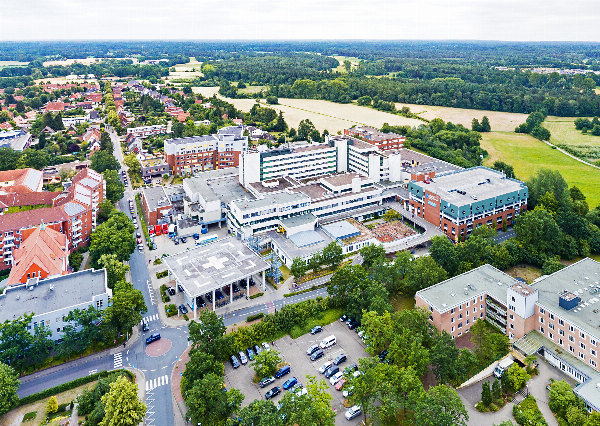
Elise-Averdieck-Str. 17
27356 Rotenburg (Wümme)
Phone:
04261-77-0
Mail:
ed.noiselpaga@rkd.ofni
ed.noiselpaga@rkd.ofni
ed.noiselpaga@rkd.ofni
- Number of beds: 725
- Number of specialist departments: 27
- Number of inpatient cases: 28.915
- Number of partial inpatient cases: 208
- Number of outpatient cases: 190.134
- Hospital owners: AGAPLESION gemeinnützige AG (60%), Evangelisch-lutherisches Diakonissen-Mutterhaus Rotenburg (Wümme) e.V. (40%)
- Type of provider: freigemeinnützig
- Academic teaching hospital
- Akademisches Lehrkrankenhaus der Medizinischen Fakultät der Universität Hamburg
- Klinik für Allgemein-, Viszeral- und Thoraxchirurgie
- Frauenklinik - Geburtshilfe und Perinatologie
- Klinik für Kardiologie
- Klinik für Hämatologie-Onkologie, Nephrologie und Geriatrie
- Klinik für Gastroenterologie, Diabetologie, Endokrinologie - Hepatologie und Ernährungsmedizin
- Zentrum für Pneumologie
- Zentrum für Palliativmedizin und Psychoonkologie
- Neurologische Klinik
- Klinik für Kinder und Jugendliche
- Zentrum für Psychiatrie und Psychotherapie
- Klinik für Psychosomatische Medizin und Psychotherapie
- Klinik für Unfallchirurgie und Orthopädie, Kinderorthopädie
- Institut für Anästhesie und Intensivmedizin
- Institut für Diagnostische und Interventionelle Radiologie/Neuroradiologie
- Klinik für Strahlentherapie und Radioonkologie
- Institut und MVZ Fachbereich Nuklearmedizin und Schilddrüsendiagnostik
- Pathologisches Institut
- MVZ Fachbereich Physikalische und Rehabilitative Medizin
- Belegabteilung und MVZ Fachbereich Dermatologie
- Belegabteilung Augenheilkunde
- Klinik für Gefäßchirurgie und Endovaskuläre Chirurgie
- Klinik für Plastisch-Ästhetische und Rekonstruktive Chirurgie, Handchirurgie
- Neurochirurgische Klinik
- Klinik für Mund-, Kiefer- und Plastische Gesichtschirurgie
- Hals-Nasen-Ohren-Klinik
- Klinik für Urologie
- Frauenklinik - Gynäkologie und gynäkologische Onkologie
Further information
- External quality assurance according to state law
No participation
Diabetes mellitus Typ 2
Als Klinik mit diabetologischem Schwerpunkt findet auch eine Teilnahme am Disease-Management-Programm Diabetes Mellitus Typ 2 statt.
| Quantity performed | 156 |
| Exception? | No exception |
| Quantity performed | 73 |
| Exception? | No exception |
| Quantity performed | 24 |
| Exception? | No exception |
| Quantity performed | 14 |
| Exception? | No exception |
| Quantity performed | 38 |
| Exception? | No exception |
| Overall result forecast presentation: | yes |
| Quantity performed reporting year: | 156 |
| Quantity forecast year: | 156 |
| Examination by state associations? | yes |
| Exemption? | yes |
| Result of the examination by the federal state authorities? | yes |
| Transitional arrangement? | no |
| Overall result forecast presentation: | yes |
| Quantity performed reporting year: | 73 |
| Quantity forecast year: | 60 |
| Examination by state associations? | yes |
| Exemption? | yes |
| Result of the examination by the federal state authorities? | yes |
| Transitional arrangement? | no |
| Overall result forecast presentation: | yes |
| Quantity performed reporting year: | 24 |
| Quantity forecast year: | 26 |
| Examination by state associations? | yes |
| Exemption? | yes |
| Result of the examination by the federal state authorities? | yes |
| Transitional arrangement? | no |
| Overall result forecast presentation: | yes |
| Quantity performed reporting year: | 14 |
| Quantity forecast year: | 14 |
| Examination by state associations? | yes |
| Exemption? | yes |
| Result of the examination by the federal state authorities? | yes |
| Transitional arrangement? | no |
| Overall result forecast presentation: | no |
| Quantity performed reporting year: | 38 |
| Quantity forecast year: | 32 |
| Examination by state associations? | no |
| Exemption? | no |
| Result of the examination by the federal state authorities? | no |
| Transitional arrangement? | no |
| No. | Explanation |
|---|---|
| CQ01 | Quality assurance measures for inpatient care with the indication abdominal aortic aneurysm |
| CQ25 | Measures for quality assurance in the performance of minimally invasive heart valve interventions pursuant to Article 136, para. 1, sentence 1, number 2 for hospitals licensed in accordance with Article 108 of the SGB V |
| CQ28 | Guideline on quality assurance measures for liposuction procedures for stage III lipedema (QS-RL Liposuction) |
| CQ06 | Measures for quality assurance in the care of pre-term and full-term neonates – Perinatal Centre LEVEL 2 |
- Clarifying chat completed: no
- Clarifying chat not completed: no
- No participation in clarifying chat: no
- Notification of non-fulfilment of nursing care not made: yes
quarter Q1
Erwachsenenpsychiatrie
| Day shift | ||
|---|---|---|
| Compliance with minimum requirements | no | |
| Level of implementation | 84,0 % | |
| Occupational group | Minimum requirements met | Level of implementation (%) |
| Ärztinnen und Ärzte, ärztliche Psychotherapeutinnen und Psychotherapeuten | ja | 128,73 % |
| Pflegefachpersonen | nein | 72,67 % |
| Psychotherapeutinnen und Psychotherapeuten (ohne ärztliche Psychotherapeutinnen und Psychotherapeuten), Psychologinnen und Psychologen | ja | 134,47 % |
| Spezialtherapeutinnen und Spezialtherapeuten | nein | 59,86 % |
| Bewegungstherapeutinnen und Bewegungstherapeuten, Physiotherapeutinnen und Physiotherapeuten | ja | 96,91 % |
| Sozialarbeiterinnen und Sozialarbeiter, Sozialpädagoginnen und Sozialpädagogen, Heilpädagoginnen und Heilpädagogen | ja | 121,27 % |
| Night shift | ||
| Compliance with minimum requirements | yes | |
| Minimum requirement (full-time staff) | 71 | |
| Current staffing levels (full-time staff) | 82 | |
| Number of nights, subject to the minimum requirement | 84 | |
Psychosomatik
| Day shift | ||
|---|---|---|
| Compliance with minimum requirements | no | |
| Level of implementation | 125,0 % | |
| Occupational group | Minimum requirements met | Level of implementation (%) |
| Ärztinnen und Ärzte, ärztliche Psychotherapeutinnen und Psychotherapeuten | ja | 102,89 % |
| Pflegefachpersonen | ja | 110,19 % |
| Psychotherapeutinnen und Psychotherapeuten (ohne ärztliche Psychotherapeutinnen und Psychotherapeuten), Psychologinnen und Psychologen | ja | 202,04 % |
| Spezialtherapeutinnen und Spezialtherapeuten | nein | 72,04 % |
| Bewegungstherapeutinnen und Bewegungstherapeuten, Physiotherapeutinnen und Physiotherapeuten | ja | 128,75 % |
| Sozialarbeiterinnen und Sozialarbeiter, Sozialpädagoginnen und Sozialpädagogen, Heilpädagoginnen und Heilpädagogen | ja | 682,69 % |
quarter Q2
Erwachsenenpsychiatrie
| Day shift | ||
|---|---|---|
| Compliance with minimum requirements | no | |
| Level of implementation | 85,0 % | |
| Occupational group | Minimum requirements met | Level of implementation (%) |
| Ärztinnen und Ärzte, ärztliche Psychotherapeutinnen und Psychotherapeuten | ja | 138,68 % |
| Pflegefachpersonen | nein | 71,79 % |
| Psychotherapeutinnen und Psychotherapeuten (ohne ärztliche Psychotherapeutinnen und Psychotherapeuten), Psychologinnen und Psychologen | ja | 115,09 % |
| Spezialtherapeutinnen und Spezialtherapeuten | nein | 54,22 % |
| Bewegungstherapeutinnen und Bewegungstherapeuten, Physiotherapeutinnen und Physiotherapeuten | nein | 69,16 % |
| Sozialarbeiterinnen und Sozialarbeiter, Sozialpädagoginnen und Sozialpädagogen, Heilpädagoginnen und Heilpädagogen | ja | 158,71 % |
| Night shift | ||
| Compliance with minimum requirements | yes | |
| Minimum requirement (full-time staff) | 71 | |
| Current staffing levels (full-time staff) | 80 | |
| Number of nights, subject to the minimum requirement | 84 | |
Psychosomatik
| Day shift | ||
|---|---|---|
| Compliance with minimum requirements | yes | |
| Level of implementation | 150,0 % | |
| Occupational group | Minimum requirements met | Level of implementation (%) |
| Ärztinnen und Ärzte, ärztliche Psychotherapeutinnen und Psychotherapeuten | ja | 156,73 % |
| Pflegefachpersonen | ja | 127,47 % |
| Psychotherapeutinnen und Psychotherapeuten (ohne ärztliche Psychotherapeutinnen und Psychotherapeuten), Psychologinnen und Psychologen | ja | 237,1 % |
| Spezialtherapeutinnen und Spezialtherapeuten | ja | 96,5 % |
| Bewegungstherapeutinnen und Bewegungstherapeuten, Physiotherapeutinnen und Physiotherapeuten | ja | 113,41 % |
| Sozialarbeiterinnen und Sozialarbeiter, Sozialpädagoginnen und Sozialpädagogen, Heilpädagoginnen und Heilpädagogen | ja | 652,68 % |
quarter Q3
Erwachsenenpsychiatrie
| Day shift | ||
|---|---|---|
| Compliance with minimum requirements | no | |
| Level of implementation | 88,0 % | |
| Occupational group | Minimum requirements met | Level of implementation (%) |
| Ärztinnen und Ärzte, ärztliche Psychotherapeutinnen und Psychotherapeuten | ja | 142,62 % |
| Pflegefachpersonen | nein | 74,65 % |
| Psychotherapeutinnen und Psychotherapeuten (ohne ärztliche Psychotherapeutinnen und Psychotherapeuten), Psychologinnen und Psychologen | ja | 129,71 % |
| Spezialtherapeutinnen und Spezialtherapeuten | nein | 55,1 % |
| Bewegungstherapeutinnen und Bewegungstherapeuten, Physiotherapeutinnen und Physiotherapeuten | ja | 104,29 % |
| Sozialarbeiterinnen und Sozialarbeiter, Sozialpädagoginnen und Sozialpädagogen, Heilpädagoginnen und Heilpädagogen | ja | 147,59 % |
| Night shift | ||
| Compliance with minimum requirements | yes | |
| Minimum requirement (full-time staff) | 71 | |
| Current staffing levels (full-time staff) | 81 | |
| Number of nights, subject to the minimum requirement | 84 | |
Psychosomatik
| Day shift | ||
|---|---|---|
| Compliance with minimum requirements | no | |
| Level of implementation | 150,0 % | |
| Occupational group | Minimum requirements met | Level of implementation (%) |
| Ärztinnen und Ärzte, ärztliche Psychotherapeutinnen und Psychotherapeuten | ja | 123,73 % |
| Pflegefachpersonen | ja | 139,85 % |
| Psychotherapeutinnen und Psychotherapeuten (ohne ärztliche Psychotherapeutinnen und Psychotherapeuten), Psychologinnen und Psychologen | ja | 234,86 % |
| Spezialtherapeutinnen und Spezialtherapeuten | nein | 87,91 % |
| Bewegungstherapeutinnen und Bewegungstherapeuten, Physiotherapeutinnen und Physiotherapeuten | ja | 135,54 % |
| Sozialarbeiterinnen und Sozialarbeiter, Sozialpädagoginnen und Sozialpädagogen, Heilpädagoginnen und Heilpädagogen | ja | 649,92 % |
quarter Q4
Erwachsenenpsychiatrie
| Day shift | ||
|---|---|---|
| Compliance with minimum requirements | no | |
| Level of implementation | 82,0 % | |
| Occupational group | Minimum requirements met | Level of implementation (%) |
| Ärztinnen und Ärzte, ärztliche Psychotherapeutinnen und Psychotherapeuten | ja | 130,64 % |
| Pflegefachpersonen | nein | 69,27 % |
| Psychotherapeutinnen und Psychotherapeuten (ohne ärztliche Psychotherapeutinnen und Psychotherapeuten), Psychologinnen und Psychologen | ja | 136,27 % |
| Spezialtherapeutinnen und Spezialtherapeuten | nein | 66,94 % |
| Bewegungstherapeutinnen und Bewegungstherapeuten, Physiotherapeutinnen und Physiotherapeuten | nein | 65,05 % |
| Sozialarbeiterinnen und Sozialarbeiter, Sozialpädagoginnen und Sozialpädagogen, Heilpädagoginnen und Heilpädagogen | ja | 116,59 % |
| Night shift | ||
| Compliance with minimum requirements | yes | |
| Minimum requirement (full-time staff) | 71 | |
| Current staffing levels (full-time staff) | 82 | |
| Number of nights, subject to the minimum requirement | 84 | |
Psychosomatik
| Day shift | ||
|---|---|---|
| Compliance with minimum requirements | no | |
| Level of implementation | 123,0 % | |
| Occupational group | Minimum requirements met | Level of implementation (%) |
| Ärztinnen und Ärzte, ärztliche Psychotherapeutinnen und Psychotherapeuten | ja | 94,26 % |
| Pflegefachpersonen | ja | 123,82 % |
| Psychotherapeutinnen und Psychotherapeuten (ohne ärztliche Psychotherapeutinnen und Psychotherapeuten), Psychologinnen und Psychologen | ja | 201,87 % |
| Spezialtherapeutinnen und Spezialtherapeuten | nein | 40,61 % |
| Bewegungstherapeutinnen und Bewegungstherapeuten, Physiotherapeutinnen und Physiotherapeuten | nein | 39,66 % |
| Sozialarbeiterinnen und Sozialarbeiter, Sozialpädagoginnen und Sozialpädagogen, Heilpädagoginnen und Heilpädagogen | ja | 629,26 % |
| Number | Group |
|---|---|
| 224 | Medical specialists (m/f) , psychological psychotherapists (m/f) and child and adolescent psychotherapists (m/f) who are subject to the obligation to undergo further training* |
| 17 | Number of medical specialists (m/f) from no. 1 who have completed a five-year period of further training and are therefore subject to the obligation to provide evidence |
| 3 | Number of those persons from no. 2 who have provided proof of further training according to Article 3 of the G-BA regulations |
According to Section 4 (2) of the Quality Management Guideline, facilities must provide for the prevention of and intervention in cases of violence and abuse as part of their internal quality management. The aim is to prevent, recognise and respond appropriately to abuse and violence, particularly against vulnerable patient groups such as children and adolescents or people in need of help, and also to prevent it within the facility. The respective procedure is aligned with the size of the facility, the range of services and the patients in order to define customised solutions for sensitising the teams as well as other suitable preventative and interventional measures. These may include information materials, contact addresses, training/education, codes of conduct, recommendations for action/intervention plans or comprehensive protection concepts.
- Is a protection concept in place? Yes
- Measures
-
Prevention
Education
Information gathering on the topic
Training of employees
- Note on the measure
AGAPLESION Rahmenkonzeption liegt vor
- Last review of the measure
26.08.2021 21:22:35
- Note on the measure
-
Intervention
- Note on the measure
AGAPLESION Rahmenkonzeption liegt vor
- Last review of the measure
26.08.2021 21:22:35
- Note on the measure
-
Review
- Note on the measure
AGAPLESION Rahmenkonzeption liegt vor
- Last review of the measure
26.08.2021 21:22:35
- Note on the measure
-
Prevention
- AGAPLESION Rahmenkonzeption liegt vor
- Drug commission
Training of employees on AMTS related topics
Electronic support for the admission and anamnesis process (e.g. import of patient master data or medication plans, use of a drug knowledge database, input screen for drugs or anamnesis information)
Verfahrensanweisungen zur Anordnung, Freigabe, Stellen der Medikamente (4-Augen-Prinzip) und Dokumentation verabreichter Medikamente
21.04.2020
Possibility of electronic prescription i.e. structured entry of active substances (or name of the preparation), form, dose, dose frequency (e.g. in the HIS, in prescription software)
Provision of one or more electronic drug information systems (e.g. Lauer-Taxe®, ifap klinikCenter®, Gelbe Liste®, Fachinfo-Service®)
- Anwendung von gebrauchsfertigen Arzneimitteln bzw. Zubereitungen
- Bereitstellung einer geeigneten Infrastruktur zur Sicherstellung einer fehlerfreien Zubereitung
- Zubereitung durch pharmazeutisches Personal
- Vorhandensein von elektronischen Systemen zur Entscheidungsunterstützung (z.B. Meona®, Rpdoc®, AIDKlinik®, ID Medics® bzw. ID Diacos® Pharma)
- Verwendung einer Software zur Unterstützung der Arzneimitteltherapiesicherheit und der Indikation von Medikationsfehlern
Electronic documentation of the administration of drugs
- Fallbesprechungen
- Maßnahmen zur Vermeidung von Arzneimittelverwechslung
- Spezielle AMTS-Visiten (z. B. pharmazeutische Visiten, antibiotic stewardship, Ernährung)
- Teilnahme an einem einrichtungsübergreifenden Fehlermeldesystem (siehe Kapitel 12.2.3.2)
- Vier-Augen-Prinzip beim Zusammenstellen der Medikation auf Station
- Risiken und Fehler werden systematisch untersucht und reduziert (Sound-alike oder Look-alike Medikamente)
- Elektronische Überprüfung über Anordnung in digitaler Patientenakte mit Identifizierung des angeordneten Medikamentes durch Abgleich nach Einscannen der PZN-Nummer und des Patientenidentifikationsarmbands
- Aushändigung von Patienteninformationen zur Umsetzung von Therapieempfehlungen
- Aushändigung des Medikationsplans
- bei Bedarf Arzneimittel-Mitgabe oder Ausstellung von Entlassrezepten
- Admission to hospital, including anamnesis
; Instruments and measures are presented for determining the old medication (drug history), the subsequent clinical assessment and the switch to the medication available in the hospital (house list), as well as for documenting both the patient's original medication and that for hospital treatment adapted medication.
- Medication process in the hospital
In this context, the following sub-processes are assumed as examples: drug history - prescription - patient information - drug delivery - drug use - documentation - therapy monitoring - result assessment. Instruments and measures for safe medication prescription can be presented, e.g. B. in terms of readability, clarity and completeness of the documentation, but also in terms of area of application, effectiveness, benefit-risk ratio, tolerability (including potential contraindications, interactions, etc.) and resource considerations. Information can also be provided to support reliable medication ordering, delivery and use or administration.
- Discharge
In particular, the measures taken by hospitals can be presented to ensure that information on drug therapy is structured and passed on to doctors and physicians providing further treatment, as well as the appropriate provision of patients with drug information, medication plans and medications. Drug prescriptions are made.
Job
FL09 - Doctoral supervision
Explanation
Explanation
in Göttingen, Berlin, München, Münster, Hannover, Hamburg, Campus Homburg/Saar, Basel (Schweiz), Kwame Nkrumah Universität für Wissenschaft und Technik (KNUST) in Kumasi (Ghana), Marian University Indianapolis/USA, Anhui Medical University, Hefei Anhui/China
Explanation
Publikationen sind der Internetseite des Klinikums "www.diako-online.de/leistungsspektrum/publikationen" zu entnehmen.
Explanation
u.a: CAPNETZ, GRACE, TB-NET: Kompetenznetzwerke; verschiedene AIO Studien, Registerstudien
Explanation
u.a. mit der Medizinischen Hochschule Hannover (MHH), Klinikum der Johann Wolfgang Goethe-Universität Frankfurt, Universität Hamburg (UKE), WWU Münster , Uni Oldenburg
Explanation
PJ-Angebot für Studierende aller deutschen medizinischen Fakultäten inkl. strukturierter wöchentlicher PJ-Fortbildung; auch in Teilzeit möglich; OP-Assistenz; kostenlose Dienstkleidung; kostenlose Unterbringung; Möglichkeit von der Assistenzarztausbildung bis zum Facharzt
FL05 - Participation in multi-centre Phase I/II studies
Explanation
Explanation
Onkologie (z.B. bei Brustkrebs), Atemwegserkrankungen, Infektiologie, Kardiologie, Gastroenterologie, Allgemein- und Viszeralchirurgie, Pneumologie (Antibiotika, Impfstoffe)
Training in other healing professions
Comment
Internationaler Studiengang Hebammen (B.Sc.) – Koop. mit der Hochschule Bremen; Die Regelstudienzeit beträgt 8 Semester und schließt mit einem Bachelor of Science und einer staatl. Prüfung zur Erlangung d.Erlaubnis zum Führen der Berufsbezeichnung „Hebamme“ ab. (Praxiseinsätze im Diakonieklinikum)
Comment
In der Praxis für Ergotherapie kann die prakt. Ausbildung inkl. der prakt. Prüfung (versch. Berufsfachschulen) absolviert werden. Die ltd. Ergotherapeutin verfügt über die unbefristete Unterrichtsgenehmigung in Zusammenarbeit mit der BBA Oldenburg und ist berechtigt, prakt. Prüfungen abzunehmen.
Comment
In Ausbildung befindliche Physiotherapeuten können am Diakonieklinikum in Zusammenarbeit mit dem AGAPLESION REHAZENTRUM ROTENBURG ihre Praktika in allen Bereichen der Physiotherapie ableisten. Auch die praktische Prüfung des Staatsexamens wird an unserem Haus durchgeführt.
Comment
Ausbildungs- oder Studiumspraktikum für: Logopäden/Atem-, Sprech- und Stimmlehrerinnen nach Schlaffhorst-Andersen/Sprachheilpädagogen/Klinische Linguisten
Comment
Die Ausbildung beginnt jeweils zum 1. Oktober eines Jahres und dauert drei Jahre. Sie beinhaltet theoretischen und praktischen Unterricht an der Berufsschule IWK Delmenhorst sowie die praktische Ausbildung im Zentral-OP unseres Diakonieklinikums.
Comment
Die Ausbildung erfolgt an einer MTRA-Schule. Praxiseinsätze sind bei uns möglich. Weiterhin besteht die Möglichkeit, ein Stipendium für die Ausbildungszeit zu erhalten.
Comment
Generalistische Ausbildung: Beginn jedes Jahr 1. August; Intensiver, praxisnaher Theorieunterricht; Praxiseinsätze auf Stationen des AGAPLESION DIAKONIEKLINIKUMS ROTENBURG, kooperierenden Einrichtungen der ambulanten Pflege und stationären Langzeitpflege; drei Ausbildungsjahre
Comment
Die Ausbildung beginnt jeweils zum 1. Oktober eines Jahres und dauert drei Jahre. Sie beinhaltet theoretischen und praktischen Unterricht an der Berufsschule IWK Delmenhorst sowie die praktische Ausbildung im Zentral-OP unseres Diakonieklinikums.
Comment
Internationaler Studiengang Pflegeberufe (B.Sc.) - Kooperation mit der HS Bremen; Die Regelstudienzeit beträgt 8 Semester und schließt mit einem Bachelor of Science und einer staatl. Prüfung mit dem Ziel der Berufszulassung als Pflegefachfrau oder Pflegefachmann. Praxiseinsätze im Diakonieklinikum.
Comment
Während dem Teil der praktischen Ausbildung werden die Bereiche Allgemeinstation, Psychiatrie, Anästhesie und Intensivmedizin durchlaufen.
- Hospital staff
- Number of pharmacists: 8
- Additional staff: 11
Dr. med. Gerd Smolka
Patientenfürsprecher
Elise-Averdieck-Str. 17
27356 Rotenburg (Wümme)
Phone:
0162
-2647-209
Mail:
ed.noiselpaga@RKD.rehcerpsreufnetneitap
Annette Heinrich
Hausmanagement
Elise-Averdieck-Str. 17
27356 Rotenburg (Wümme)
Phone:
04261
-77-2010
Mail:
ed.noiselpaga@rkd.gnuniem-erhi
Iris Kahnert
Sekretariat Theologischer Direktor
Elise-Averdieck-Str. 17
27356 Rotenburg (Wümme)
Phone:
04261
-77-2213
Mail:
ed.noiselpaga@rkd.gnuniem-erhi
Frau Britta Weber
Qualitäts- und Risikomanagerin
Elise-Averdieck-Str. 17
27356 Rotenburg (Wümme)
Phone:
04261
-77-2100
Mail:
ed.noiselpaga@rebeW.attirB
Herr Christian Hader
Leiter der Apotheke
Elise-Averdieck-Str. 17
27356 Rotenburg (Wümme)
Phone:
04261
-77-6390
Mail:
ed.noiselpaga@redah.naitsirhc
Case Management Medizinisches Zentrum für Erwachsene mit geistiger oder mehrfacher Behinderung (MZEB)
Koordination/Ambulanz
Elise-Averdieck-Str. 17
27356 Rotenburg (Wümme)
Phone:
04261
-77-3235
Mail:
ed.noiselpaga@rkd.bezm
27356 Rotenburg (Wümme)
Phone:
04261-77-0
Mail:
ed.noiselpaga@rkd.ofni
Natascha Möller-Seseke
Pflegedirektorin
Elise-Averdieck-Str. 17
27356 Rotenburg (Wümme)
Phone:
04261
-77-2400
Mail:
ed.noiselpaga@pmakeneok.ardnas
Herr Klaas-Konrad Behrens
Kaufmännischer Direktor, Prokurist
Elise-Averdieck-Str. 17
27356 Rotenburg (Wümme)
Phone:
04261
-77-2205
Mail:
ed.noiselpaga@neknhaM.nitsreK
Frau Mirja Büttner
Klinikmanagerin
Elise-Averdieck-Str. 17
27356 Rotenburg (Wümme)
Phone:
04261
-77-2213
Mail:
ed.noiselpaga@rentteuB.ajriM
Herr Niklas Kuhrmann
Klinikmanager
Elise-Averdieck-Str. 17
27356 Rotenburg (Wümme)
Phone:
04261
-77-0
Mail:
ed.noiselpaga@nnamrhuK.salkiN
Prof. Dr. med. W. Alexander Osthaus
Ärztlicher Direktor
Elise-Averdieck-Str. 17
27356 Rotenburg (Wümme)
Phone:
04261
-77-6950
Mail:
ed.noiselpaga@RKD.eisehtseanA
Frau Mareike Schmidt
Geschäftsführerin (seit 02/2025)
Elise-Averdieck-Str. 17
27356 Rotenburg (Wümme)
Phone:
04261
-77-2205
Mail:
ed.noiselpaga@neknhaM.nitsreK
Herr Sebastian von der Haar
Geschäftsführer
Elise-Averdieck-Str. 17
27356 Rotenburg (Wümme)
Phone:
04261
-77-2205
Mail:
ed.noiselpaga@RKD.tairaterkeS-FG
Pastor Lars Wißmann
Theologischer Direktor
Elise-Averdieck-Str. 17
27356 Rotenburg (Wümme)
Phone:
04261
-77-2213
Mail:
ed.noiselpaga@nnamssiw.sral
Herr Sebastian von der Haar
Geschäftsführer
Elise-Averdieck-Str. 17
27356 Rotenburg (Wümme)
Phone:
04261
-77-2205
Mail:
ed.noiselpaga@neknhaM.nitsreK
Dr. med. Michael Feldmann
Stellvertretender Ärztlicher Direktor
Elise-Averdieck-Str. 17
27356 Rotenburg (Wümme)
Phone:
04261
-77-2840
Mail:
ed.noiselpaga@neiksel.einalem
Prof. Dr. med. W. Alexander Osthaus
Ärztlicher Direktor
Elise-Averdieck-Str. 17
27356 Rotenburg (Wümme)
Phone:
04261
-77-6950
Mail:
ed.noiselpaga@RKD.eisehtseanA
IK: 260330452
Location number: 773303000
Brustkrebszentrum
Certified until: 08.2027
Chest Pain Unit
Certified until: 04.2029
EndoProthetikZentrum
Certified until: 09.2027
Gefäßzentrum
Certified until: 09.2027
Stroke Unit
Certified until: 03.2027
Zentrum für Adipositas- und metabolische Chirurgie
Certified until: 05.2027