
Krankenhaus Ludmillenstift
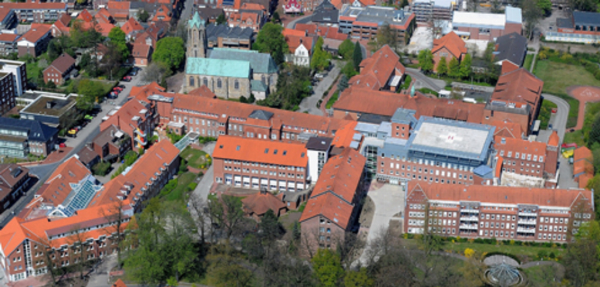
Ludmillenstraße 4-6
49716 Meppen
Phone:
05931-152-0
Mail:
ed.tfitsnellimdul@ofni
ed.tfitsnellimdul@ofni
ed.tfitsnellimdul@ofni
- Number of beds: 420
- Number of specialist departments: 15
- Number of inpatient cases: 18.285
- Number of partial inpatient cases: 39
- Number of outpatient cases: 76.000
- Hospital owners: Kuratorium der Stiftung Ludmillenstift
- Type of provider: freigemeinnützig
- Academic teaching hospital
- Carl-von-Ossietzky Universität Oldenburg
- Innere Medizin
- Augenheilkunde
- Anästhesie und Intensivmedizin
- Pathologie
- Radiologie und Neuroradiologie
- Nuklearmedizin
- Radioonkologie und Strahlentherapie
- Allgemein-, Visceral- und Gefäßchirurgie, Thoraxchirurgie
- Orthopädie und Unfallchirurgie, Hand- und Wiederherstellungschirurgie
- Neurochirurgie
- Neurologie
- Medizinische Frührehabilitation und Altersmedizin
- Frauenheilkunde und Geburtshilfe
- Kinder- und Jugendmedizin
- Hals-, Nasen-, Ohrenheilkunde
Further information
- External quality assurance according to state law
No participation
| Quantity performed | 76 |
| Exception? | No exception |
| Quantity performed | 8 |
| Exception? | No exception |
| Das Krankenhaus war zur Erbringung der mindestmengenrelevanten Leistung berechtigt, weil die Landesverbände der Krankenkassen und die Ersatzkassen die Prognose des Krankenhauses für das Berichtsjahr bestätigt hatten. Die Mindestmenge wurde im Berichtsjahr jedoch entgegen der mengenmäßigen Erwartung nicht erreicht. (MM08) | |
| Quantity performed | 11 |
| Exception? | No exception |
| Das Krankenhaus war zur Erbringung der mindestmengenrelevanten Leistung berechtigt, weil die Landesverbände der Krankenkassen und die Ersatzkassen die Prognose des Krankenhauses für das Berichtsjahr bestätigt hatten. Die Mindestmenge wurde im Berichtsjahr jedoch entgegen der mengenmäßigen Erwartung nicht erreicht. (MM08) | |
| Quantity performed | 164 |
| Exception? | No exception |
| Overall result forecast presentation: | yes |
| Quantity performed reporting year: | 76 |
| Quantity forecast year: | 76 |
| Examination by state associations? | yes |
| Exemption? | yes |
| Result of the examination by the federal state authorities? | yes |
| Transitional arrangement? | no |
| Overall result forecast presentation: | no |
| Quantity performed reporting year: | 8 |
| Quantity forecast year: | 11 |
| Examination by state associations? | no |
| Exemption? | no |
| Result of the examination by the federal state authorities? | no |
| Transitional arrangement? | no |
| Overall result forecast presentation: | no |
| Quantity performed reporting year: | 11 |
| Quantity forecast year: | 14 |
| Examination by state associations? | no |
| Exemption? | no |
| Result of the examination by the federal state authorities? | no |
| Transitional arrangement? | no |
| Overall result forecast presentation: | yes |
| Quantity performed reporting year: | 164 |
| Quantity forecast year: | 139 |
| Examination by state associations? | yes |
| Exemption? | yes |
| Result of the examination by the federal state authorities? | yes |
| Transitional arrangement? | no |
| No. | Explanation |
|---|---|
| CQ05 | Measures for quality assurance in the care of pre-term and full-term neonates – Perinatal Centre LEVEL 1 |
| CQ31 | Guideline for the care of proximal femur fractures (QSFFx-RL) |
| CQ25 | Measures for quality assurance in the performance of minimally invasive heart valve interventions pursuant to Article 136, para. 1, sentence 1, number 2 for hospitals licensed in accordance with Article 108 of the SGB V |
- Clarifying chat completed: no
- Clarifying chat not completed: no
- No participation in clarifying chat: no
- Notification of non-fulfilment of nursing care not made: yes
Full record of compliance maintained
| Number of days shown | 366 |
| Days of non-performance | 0 |
| Number of minimum requirements not met | 0 |
General minimum requirements
| Minimum requirement | Days of non-performance |
|---|---|
| Trauma room | 0 |
| Availability | 0 |
| Computed tomography (CT) | 0 |
| Intensive care beds | 0 |
| Department of Surgery | 0 |
| Forwarding by air | 0 |
| Department of Internal Medicine | 0 |
| Intensive care beds with ventilator facilities | 0 |
| Emergency care training courses | 0 |
| Treatment prioritisation system (triage) | 0 |
| Responsibility for emergency care | 0 |
Specific minimum requirements
| Minimum requirement | Days of non-performance |
|---|---|
| Doctor on duty | 0 |
| Supervision by a medical specialist | 0 |
| Geriatric expertise | 0 |
| Operating room equipment | 0 |
| Post-operative physiotherapy | 0 |
| Independent organisational unit | 0 |
Minimum requirements for process quality
| Minimum requirement | Days of non-performance |
|---|---|
| SOP: Surgical procedures | 0 |
| SOP: Perioperative Planning | 0 |
| SOP: Capacity to consent | 0 |
| Standard Operating Procedure for the Management of Anticoagulants | 0 |
| SOP: Ortho-geriatric Care | 0 |
| SOP: Physiotherapy Measures | 0 |
| SOP: Patient-centred blood management | 0 |
| Number | Group |
|---|---|
| 112 | Medical specialists (m/f) , psychological psychotherapists (m/f) and child and adolescent psychotherapists (m/f) who are subject to the obligation to undergo further training* |
| 71 | Number of medical specialists (m/f) from no. 1 who have completed a five-year period of further training and are therefore subject to the obligation to provide evidence |
| 71 | Number of those persons from no. 2 who have provided proof of further training according to Article 3 of the G-BA regulations |
According to Section 4 (2) of the Quality Management Guideline, facilities must provide for the prevention of and intervention in cases of violence and abuse as part of their internal quality management. The aim is to prevent, recognise and respond appropriately to abuse and violence, particularly against vulnerable patient groups such as children and adolescents or people in need of help, and also to prevent it within the facility. The respective procedure is aligned with the size of the facility, the range of services and the patients in order to define customised solutions for sensitising the teams as well as other suitable preventative and interventional measures. These may include information materials, contact addresses, training/education, codes of conduct, recommendations for action/intervention plans or comprehensive protection concepts.
- Is a protection concept in place? Yes
- Measures
-
Prevention
Information gathering on the topic
Training of employees
Education
- Last review of the measure
16.08.2023 21:13:57
Age-appropriate complaint options
Special requirements for the selection of persons
- Last review of the measure
-
Intervention
- Last review of the measure
16.08.2023 21:13:57
- Last review of the measure
-
Review
- Last review of the measure
16.08.2023 21:13:57
- Last review of the measure
-
Prevention
- Drug commission
Training of employees on AMTS related topics
Availability of appropriate, topic-specific informational materials for patients on AMTS e.g. for chronic diseases, for high-risk drugs, for children
Z. B. bundeseinheitlicher Medikationsplan, Stammblatt oder Software in der Notaufnahme.
28.05.2021
Electronic support for the admission and anamnesis process (e.g. import of patient master data or medication plans, use of a drug knowledge database, input screen for drugs or anamnesis information)
AW Medikamentenverabreichung [21529]
16.02.2021
AW Medikamentenverabreichung [21529]
16.02.2021
Provision of one or more electronic drug information systems (e.g. Lauer-Taxe®, ifap klinikCenter®, Gelbe Liste®, Fachinfo-Service®)
- Bereitstellung einer geeigneten Infrastruktur zur Sicherstellung einer fehlerfreien Zubereitung
- Zubereitung durch pharmazeutisches Personal
- Anwendung von gebrauchsfertigen Arzneimitteln bzw. Zubereitungen
- Vorhandensein von elektronischen Systemen zur Entscheidungsunterstützung (z.B. Meona®, Rpdoc®, AIDKlinik®, ID Medics® bzw. ID Diacos® Pharma)
- Maßnahmen zur Vermeidung von Arzneimittelverwechslung
- Spezielle AMTS-Visiten (z. B. pharmazeutische Visiten, antibiotic stewardship, Ernährung)
- Teilnahme an einem einrichtungsübergreifenden Fehlermeldesystem (siehe Kapitel 12.2.3.2)
- Electronisch unterstütztes System zur eindeutigen Beschriftung/Etikettieruntg zubereiteter intravenösier Medikamente (PRAXIKETT® Designer)
- Aushändigung von arzneimittelbezogenen Informationen für die Weiterbehandlung und Anschlussversorgung der Patientin oder des Patienten im Rahmen eines (ggf. vorläufigen) Entlassbriefs
- Aushändigung von Patienteninformationen zur Umsetzung von Therapieempfehlungen
- Aushändigung des Medikationsplans
- bei Bedarf Arzneimittel-Mitgabe oder Ausstellung von Entlassrezepten
- Admission to hospital, including anamnesis
; Instruments and measures are presented for determining the old medication (drug history), the subsequent clinical assessment and the switch to the medication available in the hospital (house list), as well as for documenting both the patient's original medication and that for hospital treatment adapted medication.
- Medication process in the hospital
In this context, the following sub-processes are assumed as examples: drug history - prescription - patient information - drug delivery - drug use - documentation - therapy monitoring - result assessment. Instruments and measures for safe medication prescription can be presented, e.g. B. in terms of readability, clarity and completeness of the documentation, but also in terms of area of application, effectiveness, benefit-risk ratio, tolerability (including potential contraindications, interactions, etc.) and resource considerations. Information can also be provided to support reliable medication ordering, delivery and use or administration.
- Discharge
In particular, the measures taken by hospitals can be presented to ensure that information on drug therapy is structured and passed on to doctors and physicians providing further treatment, as well as the appropriate provision of patients with drug information, medication plans and medications. Drug prescriptions are made.
Job
Explanation
Frau Dr. Veer Dozentin , Campus Papenburg
FL03 - Student training (clinical traineeship / internship year)
Explanation
FL04 - Project-related cooperation with colleges and universities
Explanation
FL05 - Participation in multi-centre Phase I/II studies
Explanation
FL06 - Participation in multi-centre phase III/IV studies
Explanation
FL07 - Initiation and management of uni-centric/multi-centric clinical/scientific studies
Explanation
FL08 - Editors of scientific journals/textbooks
Explanation
FL09 - Doctoral supervision
Explanation
Training in other healing professions
HB03 - Physical therapist / physiotherapist (m/f)
Comment
Comment
In Kooperation mit Niels Stensen Bildungszentrum (Osnabrück).
Comment
Hebammenwissenschaft B.sc. in Kooperation mit der Jade Hochschuke Oldenburg
Comment
In Kooperation mit NSK Bildungsinstitut Osnabrück.
Comment
In Kooperation mit Niels Stensen Bildungszentrum (Osnabrück).
HB17 - Auxiliary nurse (m/f)
Comment
HB19 - Nursing professionals
Comment
Comment
In Kooperation mit der Hochschule Osnabrück Campus Lingen
- Hospital staff
- Number of pharmacists: 2
- Additional staff: 8
Gisela Meyer
Patientenfürsprecherin
Ludmillenstraße 4-6
49716 Meppen
Phone:
05931
-152-1093
Mail:
ed.tfitsnellimdul@rehcerpsreufnetneitap
Kathmann Iris
Qualitätsmanagment
Ludmillenstraße 4-6
49716 Meppen
Phone:
05931
-152-1048
Mail:
ed.tfitsnellimdul@mq
Kramer Vildana
Qualitätsmanagement
Ludmillenstraße 4-6
49716 Meppen
Phone:
05931
-152-1048
Mail:
ed.tfitsnellimdul@mq
Lohe Franziska
Qualitätsmanagement
Ludmillenstraße 4-6
49716 Meppen
Phone:
05931
-152-1048
Mail:
ed.tfitsnellimdul@mq
Andreas Fierdag
Qualitätsmanagementbeauftragter
Ludmillenstraße 4-6
49716 Meppen
Phone:
05931
-152-1042
Mail:
ed.tfitsnellimdul@gadreif
Jan Schmitz
Leitender Apotheker
Ludmillenstraße 4-6
49716 Meppen
Phone:
05931
-152-1900
Mail:
ed.tfitsnellimdul@ztimhcs.j
Phillipp Herbers
Ansprechpartner für Menschen mit Behinderungen
Ludmillenstraße 4-6
49716 Meppen
Phone:
05931
-152-0
Mail:
ed.tfitsnellimdul@srebreh
49716 Meppen
Phone:
05931-152-0
Mail:
ed.tfitsnellimdul@ofni
Heike Burrichter
Pflegedirektorin
Ludmillenstraße 4-6
49716 Meppen
Phone:
05931
-152-1040
Mail:
ed.tfitsnellimdul@rethcirrub
Bis zum 22.11.2024 Jan-Henning Stoffers
Geschäftsführender Verwaltungsdirektor
Ludmillenstraße 4-6
49716 Meppen
Phone:
05931
-152-1000
Mail:
ed.tfitsnellimdul@sreffots
Ab dem 22.11.2024 Stefan Lammers
Geschäftsführender Verwaltungsdirektor
Ludmillenstraße 4-6
49716 Meppen
Phone:
05931
-152-1006
Mail:
ed.tfitsnellimdul@sremmal
Herr Lutz Blume
Geschäftsführender Verwaltungsdirektor
Ludmillenstraße 4-6
49716 Meppen
Phone:
05931
-152-1000
Mail:
ed.tfitsnellimdul@emulb.ztul
Dr. med. Mario Konen
Ärztlicher Direktor
Ludmillenstraße 4-6
49716 Meppen
Phone:
05931
-152-6026
Mail:
ed.tfitsnellimdul@nenok
IK: 260340615
Location number: 773405000
Überregionales Traumazentrum im Traumanetzwerk Nord-West
Certified until: 09.2023

EndoProthetikZentrum Ludmillenstift Meppen
Certified until: 02.2024
Überregionale Stroke Unit
Certified until: 01.2023
Nachsorgeeinrichtung für Frühgeborene, schwerstkranke und schwerstbehinderte Kinder "Bunter Kreis Emsland am Ludmillenstift"
Certified until: 06.2024
Frauenklinik am Ludmillenstift mit Emsländischem Brustzentrum und Gynäkologischem Brustzentrum (DIN EN ISO 9001:2015)
Certified until: 09.2023
Chest Pain Unit (DKG zertifiziert)
Certified until: 02.2023
Kinder - und Jugendmedizin (Ausgezeichnet für Kinder)
Certified until: 12.2023
Medizinische Frührehabilitation und Altersmedizin (DEGEMED, DIN EN ISO 9001:2015)
Certified until: 03.2025
Pathologie und Zytologie (DIN EN ISO 9001:2015)
Certified until: 06.2023
EndoProthetikZentrum
Certified until: 02.2027