
Klinikum Stuttgart - Krankenhaus Bad Cannstatt (KBC)
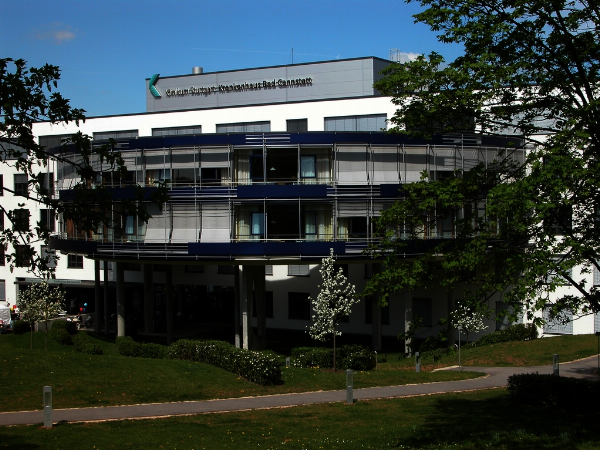
Prießnitzweg 24
70374 Stuttgart
Phone:
0711-278-00
Mail:
ed.tragttuts-mukinilk@ofni
ed.tragttuts-mukinilk@ofni
ed.tragttuts-mukinilk@ofni
- Number of beds: 752
- Number of specialist departments: 15
- Number of inpatient cases: 18.321
- Number of partial inpatient cases: 1.736
- Number of outpatient cases: 82.003
- Number of cases of inpatient-equivalent psychiatric treatment (StäB): 148
- Hospital owners: Stadt Stuttgart
- Type of provider: öffentlich
- Academic teaching hospital
- Eberhard Karls Universität Tübingen
- Interdisziplinäre Notaufnahme (CINA) (KBC)
- Klinik für Psychiatrie und Psychotherapie für Ältere (KBC)
- Klinik für Suchtmedizin und Abhängiges Verhalten (KBC)
- Klinik für Kinder- und Jugendpsychiatrie und Psychotherapie (KBC)
- Institut für Klinische Psychologie (KBC)
- Neuroradiologische Klinik (KBC)
- Klinik für Diagnostische und Interventionelle Radiologie (KBC)
- Klinik für Allgemeine Innere Medizin, Gastroenterologie, Hepatologie und internistische Onkologie (KBC)
- Klinik für Allgemein-, Viszeral-, Thorax- und Transplantationschirurgie (KBC)
- Klinik für Hand-, Plastische und Ästhetische Chirurgie (KBC)
- Sportklinik, Unfallchirurgie und Orthopädie
- Zentrum für Dermatologie, Phlebologie und Allergologie (KBC)
- Klinik für Anästhesiologie, operative Intensivmedizin, Notfallmedizin und Schmerztherapie (KBC)
- Klinik für Psychosomatische Medizin und Psychotherapie (KBC)
- Klinik für Spezielle Psychiatrie, Sozialpsychiatrie und Psychotherapie (KBC)
Further information
| Bezeichnung | |
| Teilnahme externe Qualitätssicherung | no |
| Bezeichnung | |
| Teilnahme externe Qualitätssicherung | yes |
| Bezeichnung | |
| Teilnahme externe Qualitätssicherung | does not apply |
- Quality of participation in the Disease Management Programme (DMP)
No participation
- Implementation of the minimum quantity agreement
No participation
| No. | Explanation |
|---|---|
| CQ28 | Guideline on quality assurance measures for liposuction procedures for stage III lipedema (QS-RL Liposuction) |
- Clarifying chat completed: no
- Clarifying chat not completed: no
- No participation in clarifying chat: no
- Notification of non-fulfilment of nursing care not made: no
quarter Q1
Erwachsenenpsychiatrie
| Day shift | ||
|---|---|---|
| Compliance with minimum requirements | yes | |
| Level of implementation | 94,0 % | |
| Occupational group | Minimum requirements met | Level of implementation (%) |
| Ärztinnen und Ärzte, ärztliche Psychotherapeutinnen und Psychotherapeuten | ja | 119,03 % |
| Pflegefachpersonen | nein | 89,54 % |
| Psychotherapeutinnen und Psychotherapeuten (ohne ärztliche Psychotherapeutinnen und Psychotherapeuten), Psychologinnen und Psychologen | ja | 173,64 % |
| Spezialtherapeutinnen und Spezialtherapeuten | nein | 73,52 % |
| Bewegungstherapeutinnen und Bewegungstherapeuten, Physiotherapeutinnen und Physiotherapeuten | nein | 57,96 % |
| Sozialarbeiterinnen und Sozialarbeiter, Sozialpädagoginnen und Sozialpädagogen, Heilpädagoginnen und Heilpädagogen | ja | 98,11 % |
| Night shift | ||
| Compliance with minimum requirements | yes | |
| Minimum requirement (full-time staff) | 264 | |
| Current staffing levels (full-time staff) | 198 | |
| Number of nights, subject to the minimum requirement | 0 | |
Psychosomatik
| Day shift | ||
|---|---|---|
| Compliance with minimum requirements | yes | |
| Level of implementation | 119,0 % | |
| Occupational group | Minimum requirements met | Level of implementation (%) |
| Ärztinnen und Ärzte, ärztliche Psychotherapeutinnen und Psychotherapeuten | ja | 134,54 % |
| Pflegefachpersonen | ja | 105,15 % |
| Psychotherapeutinnen und Psychotherapeuten (ohne ärztliche Psychotherapeutinnen und Psychotherapeuten), Psychologinnen und Psychologen | ja | 148,53 % |
| Spezialtherapeutinnen und Spezialtherapeuten | ja | 159,12 % |
| Bewegungstherapeutinnen und Bewegungstherapeuten, Physiotherapeutinnen und Physiotherapeuten | ja | 110,07 % |
| Sozialarbeiterinnen und Sozialarbeiter, Sozialpädagoginnen und Sozialpädagogen, Heilpädagoginnen und Heilpädagogen | nein | 24,57 % |
Kinder und Jugendpsychiatrie
| Day shift | ||
|---|---|---|
| Compliance with minimum requirements | yes | |
| Level of implementation | 89,0 % | |
| Occupational group | Minimum requirements met | Level of implementation (%) |
| Ärztinnen und Ärzte, ärztliche Psychotherapeutinnen und Psychotherapeuten | ja | 141,18 % |
| Pflegefachpersonen und Erziehungsdienst | nein | 77,72 % |
| Psychotherapeutinnen und Psychotherapeuten (ohne ärztliche Psychotherapeutinnen und Psychotherapeuten), Psychologinnen und Psychologen (dazu zählen alle Kinder- und Jugendlichenpsychotherapeutinnen und -psychotherapeuten) | nein | 87,07 % |
| Spezialtherapeutinnen und Spezialtherapeuten | ja | 98,56 % |
| Bewegungstherapeutinnen und Bewegungstherapeuten, Physiotherapeutinnen und Physiotherapeuten | ja | 172,38 % |
| Sozialarbeiterinnen und Sozialarbeiter, Sozialpädagoginnen und Sozialpädagogen, Heilpädagoginnen und Heilpädagogen | nein | 56,66 % |
| Night shift | ||
| Compliance with minimum requirements | yes | |
| Minimum requirement (full-time staff) | 28 | |
| Current staffing levels (full-time staff) | 22 | |
| Number of nights, subject to the minimum requirement | 16 | |
quarter Q2
Erwachsenenpsychiatrie
| Day shift | ||
|---|---|---|
| Compliance with minimum requirements | yes | |
| Level of implementation | 85,0 % | |
| Occupational group | Minimum requirements met | Level of implementation (%) |
| Ärztinnen und Ärzte, ärztliche Psychotherapeutinnen und Psychotherapeuten | ja | 99,23 % |
| Pflegefachpersonen | nein | 82,53 % |
| Psychotherapeutinnen und Psychotherapeuten (ohne ärztliche Psychotherapeutinnen und Psychotherapeuten), Psychologinnen und Psychologen | ja | 158,73 % |
| Spezialtherapeutinnen und Spezialtherapeuten | nein | 61,06 % |
| Bewegungstherapeutinnen und Bewegungstherapeuten, Physiotherapeutinnen und Physiotherapeuten | nein | 63,74 % |
| Sozialarbeiterinnen und Sozialarbeiter, Sozialpädagoginnen und Sozialpädagogen, Heilpädagoginnen und Heilpädagogen | nein | 79,81 % |
| Night shift | ||
| Compliance with minimum requirements | yes | |
| Minimum requirement (full-time staff) | 264 | |
| Current staffing levels (full-time staff) | 196 | |
| Number of nights, subject to the minimum requirement | 0 | |
Psychosomatik
| Day shift | ||
|---|---|---|
| Compliance with minimum requirements | yes | |
| Level of implementation | 118,0 % | |
| Occupational group | Minimum requirements met | Level of implementation (%) |
| Ärztinnen und Ärzte, ärztliche Psychotherapeutinnen und Psychotherapeuten | ja | 179,4 % |
| Pflegefachpersonen | ja | 97,41 % |
| Psychotherapeutinnen und Psychotherapeuten (ohne ärztliche Psychotherapeutinnen und Psychotherapeuten), Psychologinnen und Psychologen | ja | 111,18 % |
| Spezialtherapeutinnen und Spezialtherapeuten | ja | 112 % |
| Bewegungstherapeutinnen und Bewegungstherapeuten, Physiotherapeutinnen und Physiotherapeuten | ja | 184,72 % |
| Sozialarbeiterinnen und Sozialarbeiter, Sozialpädagoginnen und Sozialpädagogen, Heilpädagoginnen und Heilpädagogen | nein | 0 % |
Kinder und Jugendpsychiatrie
| Day shift | ||
|---|---|---|
| Compliance with minimum requirements | yes | |
| Level of implementation | 77,0 % | |
| Occupational group | Minimum requirements met | Level of implementation (%) |
| Ärztinnen und Ärzte, ärztliche Psychotherapeutinnen und Psychotherapeuten | ja | 170,08 % |
| Pflegefachpersonen und Erziehungsdienst | nein | 67,38 % |
| Psychotherapeutinnen und Psychotherapeuten (ohne ärztliche Psychotherapeutinnen und Psychotherapeuten), Psychologinnen und Psychologen (dazu zählen alle Kinder- und Jugendlichenpsychotherapeutinnen und -psychotherapeuten) | nein | 60,38 % |
| Spezialtherapeutinnen und Spezialtherapeuten | nein | 64,15 % |
| Bewegungstherapeutinnen und Bewegungstherapeuten, Physiotherapeutinnen und Physiotherapeuten | nein | 92,9 % |
| Sozialarbeiterinnen und Sozialarbeiter, Sozialpädagoginnen und Sozialpädagogen, Heilpädagoginnen und Heilpädagogen | nein | 44,83 % |
| Night shift | ||
| Compliance with minimum requirements | yes | |
| Minimum requirement (full-time staff) | 28 | |
| Current staffing levels (full-time staff) | 22 | |
| Number of nights, subject to the minimum requirement | 15 | |
quarter Q3
Erwachsenenpsychiatrie
| Day shift | ||
|---|---|---|
| Compliance with minimum requirements | yes | |
| Level of implementation | 87,0 % | |
| Occupational group | Minimum requirements met | Level of implementation (%) |
| Ärztinnen und Ärzte, ärztliche Psychotherapeutinnen und Psychotherapeuten | ja | 99,9 % |
| Pflegefachpersonen | nein | 85,28 % |
| Psychotherapeutinnen und Psychotherapeuten (ohne ärztliche Psychotherapeutinnen und Psychotherapeuten), Psychologinnen und Psychologen | ja | 162,07 % |
| Spezialtherapeutinnen und Spezialtherapeuten | nein | 56,65 % |
| Bewegungstherapeutinnen und Bewegungstherapeuten, Physiotherapeutinnen und Physiotherapeuten | nein | 49,11 % |
| Sozialarbeiterinnen und Sozialarbeiter, Sozialpädagoginnen und Sozialpädagogen, Heilpädagoginnen und Heilpädagogen | ja | 91,69 % |
| Night shift | ||
| Compliance with minimum requirements | yes | |
| Minimum requirement (full-time staff) | 264 | |
| Current staffing levels (full-time staff) | 197 | |
| Number of nights, subject to the minimum requirement | 0 | |
Psychosomatik
| Day shift | ||
|---|---|---|
| Compliance with minimum requirements | yes | |
| Level of implementation | 89,0 % | |
| Occupational group | Minimum requirements met | Level of implementation (%) |
| Ärztinnen und Ärzte, ärztliche Psychotherapeutinnen und Psychotherapeuten | ja | 142,67 % |
| Pflegefachpersonen | nein | 75,8 % |
| Psychotherapeutinnen und Psychotherapeuten (ohne ärztliche Psychotherapeutinnen und Psychotherapeuten), Psychologinnen und Psychologen | nein | 61,68 % |
| Spezialtherapeutinnen und Spezialtherapeuten | ja | 95,21 % |
| Bewegungstherapeutinnen und Bewegungstherapeuten, Physiotherapeutinnen und Physiotherapeuten | ja | 122,23 % |
| Sozialarbeiterinnen und Sozialarbeiter, Sozialpädagoginnen und Sozialpädagogen, Heilpädagoginnen und Heilpädagogen | nein | 1,38 % |
Kinder und Jugendpsychiatrie
| Day shift | ||
|---|---|---|
| Compliance with minimum requirements | yes | |
| Level of implementation | 72,0 % | |
| Occupational group | Minimum requirements met | Level of implementation (%) |
| Ärztinnen und Ärzte, ärztliche Psychotherapeutinnen und Psychotherapeuten | ja | 105,14 % |
| Pflegefachpersonen und Erziehungsdienst | nein | 66,83 % |
| Psychotherapeutinnen und Psychotherapeuten (ohne ärztliche Psychotherapeutinnen und Psychotherapeuten), Psychologinnen und Psychologen (dazu zählen alle Kinder- und Jugendlichenpsychotherapeutinnen und -psychotherapeuten) | nein | 66,93 % |
| Spezialtherapeutinnen und Spezialtherapeuten | nein | 52,43 % |
| Bewegungstherapeutinnen und Bewegungstherapeuten, Physiotherapeutinnen und Physiotherapeuten | ja | 112,39 % |
| Sozialarbeiterinnen und Sozialarbeiter, Sozialpädagoginnen und Sozialpädagogen, Heilpädagoginnen und Heilpädagogen | nein | 80 % |
| Night shift | ||
| Compliance with minimum requirements | yes | |
| Minimum requirement (full-time staff) | 28 | |
| Current staffing levels (full-time staff) | 22 | |
| Number of nights, subject to the minimum requirement | 19 | |
quarter Q4
Erwachsenenpsychiatrie
| Day shift | ||
|---|---|---|
| Compliance with minimum requirements | yes | |
| Level of implementation | 86,0 % | |
| Occupational group | Minimum requirements met | Level of implementation (%) |
| Ärztinnen und Ärzte, ärztliche Psychotherapeutinnen und Psychotherapeuten | ja | 97,47 % |
| Pflegefachpersonen | nein | 85,94 % |
| Psychotherapeutinnen und Psychotherapeuten (ohne ärztliche Psychotherapeutinnen und Psychotherapeuten), Psychologinnen und Psychologen | ja | 142,64 % |
| Spezialtherapeutinnen und Spezialtherapeuten | nein | 55,03 % |
| Bewegungstherapeutinnen und Bewegungstherapeuten, Physiotherapeutinnen und Physiotherapeuten | nein | 31,27 % |
| Sozialarbeiterinnen und Sozialarbeiter, Sozialpädagoginnen und Sozialpädagogen, Heilpädagoginnen und Heilpädagogen | nein | 86,51 % |
| Night shift | ||
| Compliance with minimum requirements | yes | |
| Minimum requirement (full-time staff) | 264 | |
| Current staffing levels (full-time staff) | 198 | |
| Number of nights, subject to the minimum requirement | 0 | |
Psychosomatik
| Day shift | ||
|---|---|---|
| Compliance with minimum requirements | yes | |
| Level of implementation | 88,0 % | |
| Occupational group | Minimum requirements met | Level of implementation (%) |
| Ärztinnen und Ärzte, ärztliche Psychotherapeutinnen und Psychotherapeuten | ja | 101,07 % |
| Pflegefachpersonen | nein | 73,12 % |
| Psychotherapeutinnen und Psychotherapeuten (ohne ärztliche Psychotherapeutinnen und Psychotherapeuten), Psychologinnen und Psychologen | ja | 97,22 % |
| Spezialtherapeutinnen und Spezialtherapeuten | ja | 105,83 % |
| Bewegungstherapeutinnen und Bewegungstherapeuten, Physiotherapeutinnen und Physiotherapeuten | ja | 189,18 % |
| Sozialarbeiterinnen und Sozialarbeiter, Sozialpädagoginnen und Sozialpädagogen, Heilpädagoginnen und Heilpädagogen | nein | 23,03 % |
Kinder und Jugendpsychiatrie
| Day shift | ||
|---|---|---|
| Compliance with minimum requirements | yes | |
| Level of implementation | 67,0 % | |
| Occupational group | Minimum requirements met | Level of implementation (%) |
| Ärztinnen und Ärzte, ärztliche Psychotherapeutinnen und Psychotherapeuten | ja | 103,12 % |
| Pflegefachpersonen und Erziehungsdienst | nein | 62,01 % |
| Psychotherapeutinnen und Psychotherapeuten (ohne ärztliche Psychotherapeutinnen und Psychotherapeuten), Psychologinnen und Psychologen (dazu zählen alle Kinder- und Jugendlichenpsychotherapeutinnen und -psychotherapeuten) | nein | 50,48 % |
| Spezialtherapeutinnen und Spezialtherapeuten | nein | 68,55 % |
| Bewegungstherapeutinnen und Bewegungstherapeuten, Physiotherapeutinnen und Physiotherapeuten | nein | 79,16 % |
| Sozialarbeiterinnen und Sozialarbeiter, Sozialpädagoginnen und Sozialpädagogen, Heilpädagoginnen und Heilpädagogen | nein | 79,64 % |
| Night shift | ||
| Compliance with minimum requirements | yes | |
| Minimum requirement (full-time staff) | 28 | |
| Current staffing levels (full-time staff) | 21 | |
| Number of nights, subject to the minimum requirement | 7 | |
| Number | Group |
|---|---|
| 63 | Medical specialists (m/f) , psychological psychotherapists (m/f) and child and adolescent psychotherapists (m/f) who are subject to the obligation to undergo further training* |
| 16 | Number of medical specialists (m/f) from no. 1 who have completed a five-year period of further training and are therefore subject to the obligation to provide evidence |
| 12 | Number of those persons from no. 2 who have provided proof of further training according to Article 3 of the G-BA regulations |
According to Section 4 (2) of the Quality Management Guideline, facilities must provide for the prevention of and intervention in cases of violence and abuse as part of their internal quality management. The aim is to prevent, recognise and respond appropriately to abuse and violence, particularly against vulnerable patient groups such as children and adolescents or people in need of help, and also to prevent it within the facility. The respective procedure is aligned with the size of the facility, the range of services and the patients in order to define customised solutions for sensitising the teams as well as other suitable preventative and interventional measures. These may include information materials, contact addresses, training/education, codes of conduct, recommendations for action/intervention plans or comprehensive protection concepts.
- Is a protection concept in place? No
- Measures
-
Prevention
Information gathering on the topic
Training of employees
Education
- Last review of the measure
07.10.2025 20:07:28
Age-appropriate complaint options
Special requirements for the selection of persons
Other aspects of prevention
- Last review of the measure
-
Intervention
- Last review of the measure
07.10.2025 20:07:28
Other aspects of intervention
- Last review of the measure
-
Review
- Last review of the measure
07.10.2025 20:07:28
Other information on recognition
- Last review of the measure
-
Prevention
- Letzte Aktualisierung 22.01.2024
- Drug commission
Training of employees on AMTS related topics
Availability of appropriate, topic-specific informational materials for patients on AMTS e.g. for chronic diseases, for high-risk drugs, for children
Electronic support for the admission and anamnesis process (e.g. import of patient master data or medication plans, use of a drug knowledge database, input screen for drugs or anamnesis information)
Risikomanagement Handbuch August 23 und Richtlinie zum Qualitäts- und klinischen Risikomanagement am Klinikum Stuttgar
04.06.2025
Possibility of electronic prescription i.e. structured entry of active substances (or name of the preparation), form, dose, dose frequency (e.g. in the HIS, in prescription software)
Provision of one or more electronic drug information systems (e.g. Lauer-Taxe®, ifap klinikCenter®, Gelbe Liste®, Fachinfo-Service®)
- Bereitstellung einer geeigneten Infrastruktur zur Sicherstellung einer fehlerfreien Zubereitung
- Zubereitung durch pharmazeutisches Personal
- Anwendung von gebrauchsfertigen Arzneimitteln bzw. Zubereitungen
Electronic documentation of the administration of drugs
- Fallbesprechungen
- Maßnahmen zur Vermeidung von Arzneimittelverwechslung
- Spezielle AMTS-Visiten (z. B. pharmazeutische Visiten, antibiotic stewardship, Ernährung)
- Teilnahme an einem einrichtungsübergreifenden Fehlermeldesystem (siehe Kapitel 12.2.3.2)
- Aushändigung des Medikationsplans
- bei Bedarf Arzneimittel-Mitgabe oder Ausstellung von Entlassrezepten
- Admission to hospital, including anamnesis
; Instruments and measures are presented for determining the old medication (drug history), the subsequent clinical assessment and the switch to the medication available in the hospital (house list), as well as for documenting both the patient's original medication and that for hospital treatment adapted medication.
- Medication process in the hospital
In this context, the following sub-processes are assumed as examples: drug history - prescription - patient information - drug delivery - drug use - documentation - therapy monitoring - result assessment. Instruments and measures for safe medication prescription can be presented, e.g. B. in terms of readability, clarity and completeness of the documentation, but also in terms of area of application, effectiveness, benefit-risk ratio, tolerability (including potential contraindications, interactions, etc.) and resource considerations. Information can also be provided to support reliable medication ordering, delivery and use or administration.
- Discharge
In particular, the measures taken by hospitals can be presented to ensure that information on drug therapy is structured and passed on to doctors and physicians providing further treatment, as well as the appropriate provision of patients with drug information, medication plans and medications. Drug prescriptions are made.
Job
Explanation
Die meisten Chefärzte sind als Privatdozenten oder Professoren an Medizinischen Fakultäten in Deutschland tätig.
FL02 - Lectureships / teaching posts at universities of applied sciences
Explanation
Explanation
Das Klinikum Stuttgart ist Akademisches Lehrkrankenhaus der Universität Tübingen. https://www.klinikum-stuttgart.de/medizin-pflege/anaesthesiologie/fort-und-weiterbildung/pj-studierende
Explanation
Es finden Kooperationen mit verschiedenen Hochschulen im In- und Ausland im Rahmen öffentlich geförderter Verbundprojekte bzw. Studiengruppen statt.
Explanation
Phase I Studien werden nicht durchgeführt, aber multizentrische Phase II Studien.
Explanation
Eine Vielzahl der Kliniken und Institute des Klinikums Stuttgart nimmt an Multicenterstudien der Phase III und IV teil. Nähere Angaben zu den Studien finden Sie im Geschäftsbericht des Klinikums Stuttgart unter www.klinikum-stuttgart.de.
Explanation
Es werden insbesondere in der Onkologie sowie in Einzelfällen auch in anderen Bereichen klinische Studien initiiert und geleitet.
Explanation
Mehrere Ärztliche Direktoren sind an der Herausgeberschaft wissenschaftlicher Journale beteiligt.
Explanation
Mehrere Ärztliche Direktoren betreuen Doktoranden.
Training in other healing professions
Comment
In Kooperation mit den Kreiskliniken Reutlingen: https://www.klinikum-stuttgart.de/karriere/
Comment
https://www.klinikum-stuttgart.de/karriere/
Comment
https://www.klinikum-stuttgart.de/karriere/
Comment
Es bestehen Kooperationsverträge mit Ausbildungszentren, für die Praktikumsplätze angeboten werden. Weitere Informationenen finden Sie unter https://www.klinikum-stuttgart.de/karriere.
Comment
https://www.klinikum-stuttgart.de/karriere/
Comment
In Kooperation mit der DHBW: https://www.klinikum-stuttgart.de/karriere
Comment
https://www.klinikum-stuttgart.de/karriere
Comment
Es bestehen Kooperationsverträge mit Ausbildungszentren, für die Praktikumsplätze angeboten werden. Weitere Informationenen finden Sie unter https://www.klinikum-stuttgart.de/karriere.
Comment
https://www.klinikum-stuttgart.de/karriere
Comment
Es bestehen Kooperationsverträge mit Ausbildungszentren, für die Praktikumsplätze angeboten werden. Weitere Informationenen finden Sie unter https://www.klinikum-stuttgart.de/karriere.
Comment
https://www.klinikum-stuttgart.de/karriere/
Comment
https://www.klinikum-stuttgart.de/karriere
Comment
In Kooperation mit den Kreiskliniken Reutlingen: https://www.klinikum-stuttgart.de/karriere/
Comment
In Kooperation mit den Kreiskliniken Reutlingen: https://www.klinikum-stuttgart.de/karriere/
- Hospital staff
- Explanations: Die 21 Apotheker und 21 pharmazeutisch technischen Assistenten (PTA) sind für alle Standorte des Klinikum Stuttgarts zuständig und werden am Standort Katharinenhospital ausgewiesen.
Jürgen Kleinat
Beschwerdemanager
Prießnitzweg 24
70374 Stuttgart
Phone:
0711
-278-32126
Mail:
ed.tragttuts-mukinilk@tanielk.j
Dr. Matthias Fabian
Qualitätsmanagement - Medizinprozesse
Prießnitzweg 24
70374 Stuttgart
Phone:
0711
-278-32183
Mail:
ed.tragttuts-mukinilk@naibaf.m
Holger Hennig
Direktor der Apotheke
Prießnitzweg 24
70374 Stuttgart
Phone:
0711
-278-34600
Mail:
ed.tragttuts-mukinilk@ginneh.h
Ina Ulmer
Ansprechpartner für Menschen mit Beeinträchtigungen
Prießnitzweg 24
70374 Stuttgart
Phone:
0711
-278-32143
Mail:
ed.tragttuts-mukinilk@pacidnaH-rentraphcerpsnA
70374 Stuttgart
Phone:
0711-278-00
Mail:
ed.tragttuts-mukinilk@ofni
Oliver Hommel
Pflegedirektor
Prießnitzweg 24
70374 Stuttgart
Phone:
0711
-278-20060
Mail:
ed.tragttuts-mukinilk@lemmoh.o
Dr. Alexander Hewer (bis 31.3.23)
Kaufmännischer Vorstand
Prießnitzweg 24
70374 Stuttgart
Phone:
0711
-278-32006
Mail:
ed.tragttutS-mukinilK@dnatsroV
Marya Verdel (ab 1.1.24)
Kaufmännische Vorständin
Prießnitzweg 24
70374 Stuttgart
Phone:
0711
-278-32006
Mail:
ed.tragttutS-mukinilK@dnatsroV
Prof. Dr. med. Jan Steffen Jürgensen MBA MPH
Medizinischer Vorstand und Vorstandsvorsitzender
Prießnitzweg 24
70374 Stuttgart
Phone:
0711
-278-32001
Mail:
ed.tragttuts-mukinilk@dnatsrov
Prof. Dr. med. Jan Steffen Jürgensen MBA MPH
Medizinischer Vorstand und Vorstandsvorsitzender
Prießnitzweg 24
70374 Stuttgart
Phone:
0711
-278-32001
Mail:
ed.tragttuts-mukinilk@dnatsrov
IK: 260812364
Location number: 772787000
Zentrum für Adipositas- und metabolische Chirurgie
Certified until: 05.2028